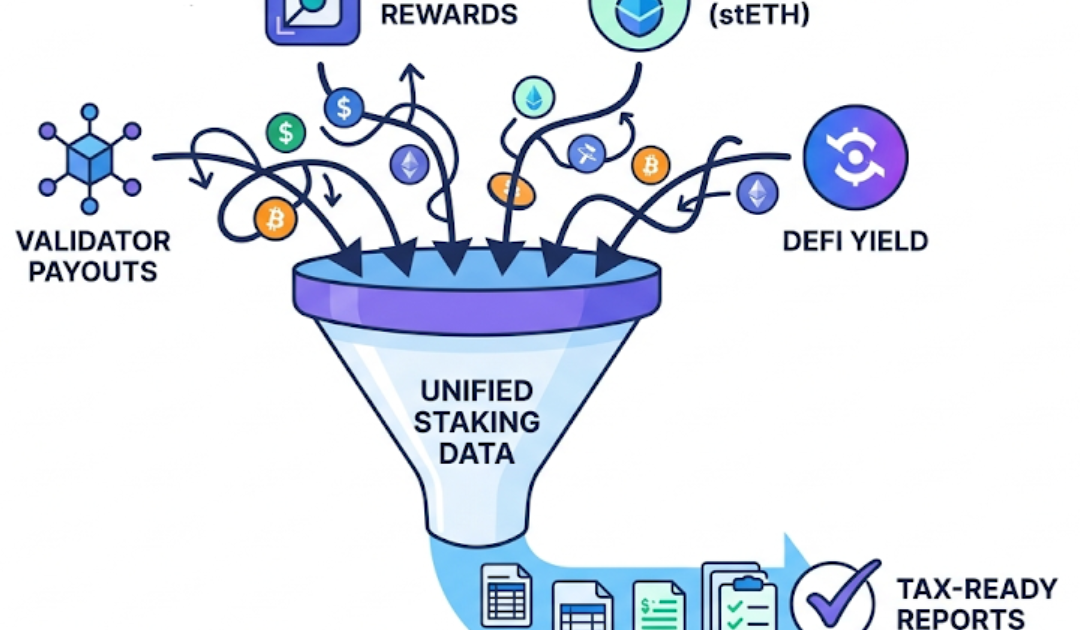
Learning how to track staking rewards for taxes sounds simple at first, until you realize how fast things can get messy. Crypto staking rewards are the extra tokens you earn by locking up your cryptocurrency to help support a blockchain network. In many countries, these rewards are taxable, which means you may need to report them as income and track their value over time.
As people use multiple wallets, exchanges, and DeFi apps, keeping accurate records of staking rewards becomes increasingly important for tax reporting. A few staking rewards across one wallet are manageable. But once you start using multiple wallets, validators, exchanges, or DeFi protocols, crypto tax reporting becomes a lot more complicated.
Every staking reward can potentially count as a taxable event. Even small daily rewards can turn into hundreds or thousands of transactions, with different timestamps, token prices, and cost basis calculations. That is where most people run into problems during tax season.
In the US, the IRS treats staking rewards tax as income once you gain “dominion and control” over the tokens. This means you can access, transfer, or sell them. Similar crypto staking tax rules also apply in countries like the UK and Australia. Regulators pay closer attention to staking income tax and DeFi taxes.
The hard part is not just understanding how staking rewards are taxed. It is figuring out how to track crypto staking rewards across wallets accurately without spending days manually updating spreadsheets.
In this guide, we will break down how crypto staking taxes work, when staking rewards become taxable, what information you need to track, and the best way to track staking rewards for taxes using both manual and automated methods.
How to Track Staking Rewards for Taxes
To track staking rewards for taxes, you need to record each reward transaction, its fair market value when received, where it came from, and whether it later triggered capital gain. Most people simplify this with a DeFi portfolio tracker that aggregates wallets and monitors staking rewards across chains automatically. But tracking balances alone is not enough for accurate crypto tax reporting. You still need to calculate staking reward income, cost basis crypto staking data, and taxable events properly.
Tools like ChainGlance help automate this process through direct integration with Bitcoin.Tax. The rest of this guide breaks everything down step by step.
Are Staking Rewards Taxable?
Yes, in most countries, staking rewards are taxable as soon as you receive them. This creates two separate taxable events. First, you may owe income tax on the value of the reward when it reaches your wallet. Then, if you later sell those tokens for a profit, you may also owe capital gains tax.
Liquid staking can make things more complicated. In some jurisdictions, swapping tokens for liquid staking assets like stETH may itself count as a taxable event. Since crypto staking tax rules continue to evolve, many investors use automated staking reward tracking tools to simplify reporting.
What You Need to Track Staking Reward for Taxes
To calculate crypto staking taxes correctly, you must track when you received the reward, what token you received, its fair market value crypto price at that moment, and where it came from. Even one missing detail can throw off your crypto tax reporting. This leads to incorrect income calculations or cost basis records later.
- Date and time received: Staking rewards become taxable when you gain control of them. Recording the exact timestamp helps determine the correct staking reward income tax amount.
- Token and quantity: Track the specific token and exact amount received, whether from standard staking, liquid staking, or DeFi protocols.
- Fair market value (FMV): Record the fair market value crypto price in your local currency at the time of receipt. This determines your taxable income and future cost basis crypto staking calculations.
- Reward source: Note whether the reward came from a validator, centralized exchange, liquid staking protocol, or DeFi platform to simplify blockchain reward tracking and crypto bookkeeping.
- Transaction hash: Save the transaction ID or hash as proof of receipt for transaction history crypto records, audits, and tax reconciliation.
How to Track Staking Rewards for Taxes
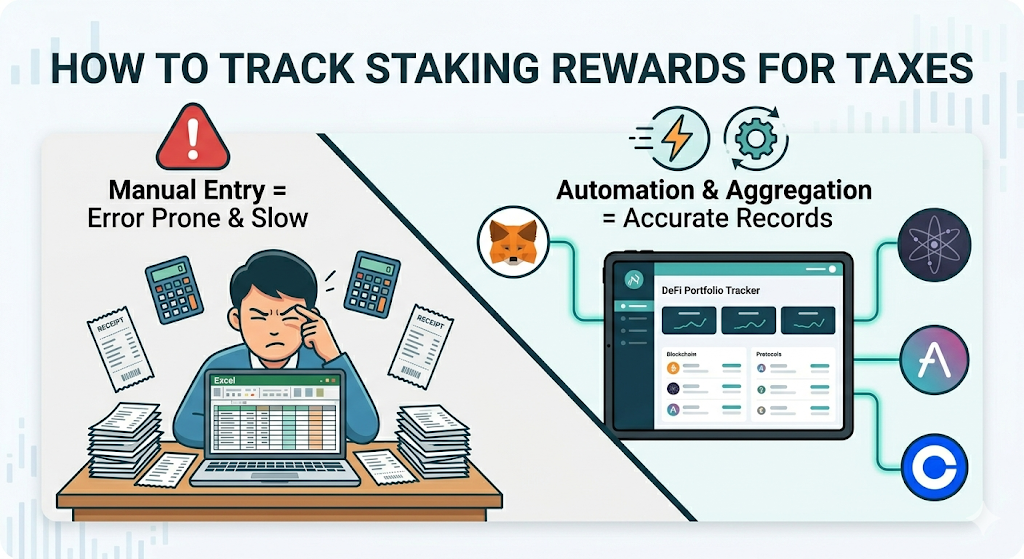
Most people track staking rewards for taxes using a DeFi portfolio tracker. These tools connect to your wallets and pull transaction history across blockchains, exchanges, and DeFi protocols into one dashboard. A good staking rewards tracker can help you monitor wallet balances, staking positions, reward history, yield farming activity, and overall crypto portfolio tracking data.
This becomes especially useful once you start staking across multiple wallets and chains. Over time, even casual DeFi users can end up with hundreds of small reward transactions spread across Ethereum, Solana, Cosmos, Layer 2s, and centralized exchanges. Portfolio trackers make blockchain reward tracking much easier to manage.
The catch is that most trackers only organize the data. They do not fully automate crypto tax reporting. You still may need to calculate staking reward income, track fair market value crypto prices, and maintain accurate cost basis records yourself.
Best Tools to Track Staking Rewards for Taxes
The best way to track staking rewards for taxes depends on how you manage your crypto. Some tools focus on portfolio tracking, while others help automate crypto tax reporting and DeFi taxes.
Popular platforms like DeBank and Zapper are widely used for tracking staking rewards, liquidity pools, and yield farming activity across multiple wallets and blockchains. Zerion offers a more mobile-friendly experience for everyday crypto portfolio tracking, while Nansen provides deeper analytics for advanced users. Privacy-focused users often prefer Llamafolio because it does not require creating an account.
The limitation with many staking rewards tracker tools, as we mentioned before, is that they track balances well but still require manual tax reconciliation. Users often need to calculate fair market value crypto prices, verify transaction history records, and organize cost basis data themselves.
Tools with direct tax integrations can simplify this process significantly. For example, ChainGlance integrates with Bitcoin.Tax to help automate staking reward tracking, fair market value calculations, and crypto tax reporting across multiple wallets and chains. This can reduce spreadsheet work and make staking income tax reporting easier during tax season.
Check out our full list of best DeFi portfolio trackers.
Common Mistakes When Tracking Staking Rewards
A few small mistakes can create major problems in your crypto tax reporting later, especially if you stake across multiple wallets and chains.
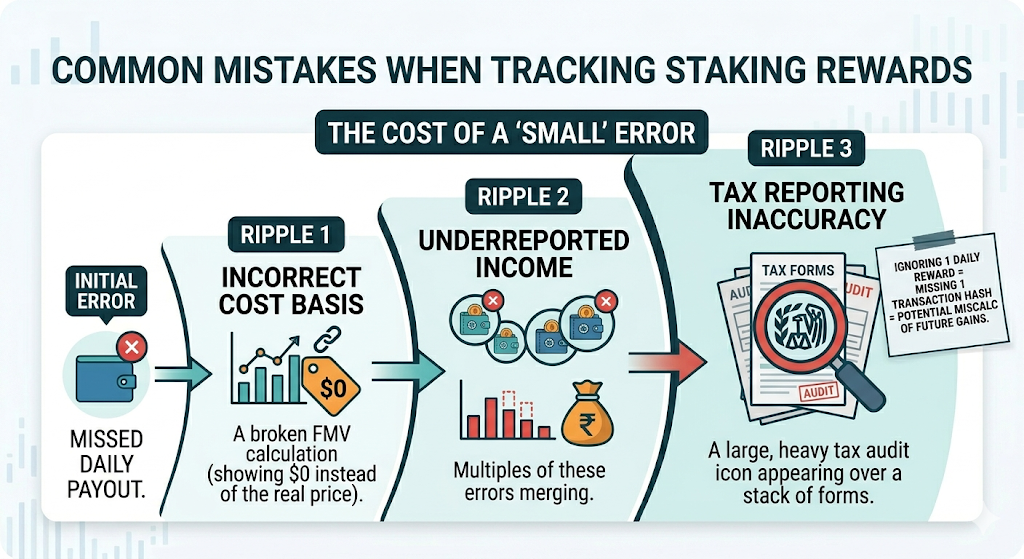
- Ignoring small rewards: Even tiny daily staking payouts can count as taxable events. Over time, those small rewards can add up to significant staking income tax obligations.
- Using the wrong FMV: Your taxable value is usually based on the fair market value price when you received the reward. Not when you checked your wallet later.
- Missing wallets or transactions: Many users forget to track staking rewards across wallets, exchanges, and blockchains, which can leave gaps in transaction history crypto records.
- Mixing up income and capital gains: Receiving staking rewards is often treated as taxable income, while selling those rewards later may trigger a separate capital gains tax event.
Read our in-depth guide on the most common mistakes in tracking your DeFi investments.
Frequently Asked Questions
Can you track staking rewards for taxes manually without software?
Yes, but it becomes difficult very quickly once you stake across multiple wallets or chains. You would need to manually record every reward, calculate the fair market value at the time of receipt, track transaction hashes, and maintain accurate cost basis records. And that doesn’t work all that well. For users with frequent rewards or DeFi activity, automated staking reward tracking tools are usually far more practical and accurate.
What happens if you forget to report staking rewards?
In many jurisdictions, staking rewards are considered taxable income, even if the rewards are small or remain in your wallet. Failing to report them can lead to inaccurate crypto tax reporting, penalties, or additional scrutiny during audits. Tax authorities like the IRS and HMRC have increased their focus on digital asset reporting in recent years.
Are auto-compounding staking rewards taxable?
In most cases, yes. Auto-compounding simply means the staking rewards are automatically restaked instead of sitting separately in your wallet. Tax authorities generally still treat those rewards as taxable once you gain economic benefit or control over them. This can make blockchain reward tracking harder because the rewards may not appear as obvious standalone transactions.