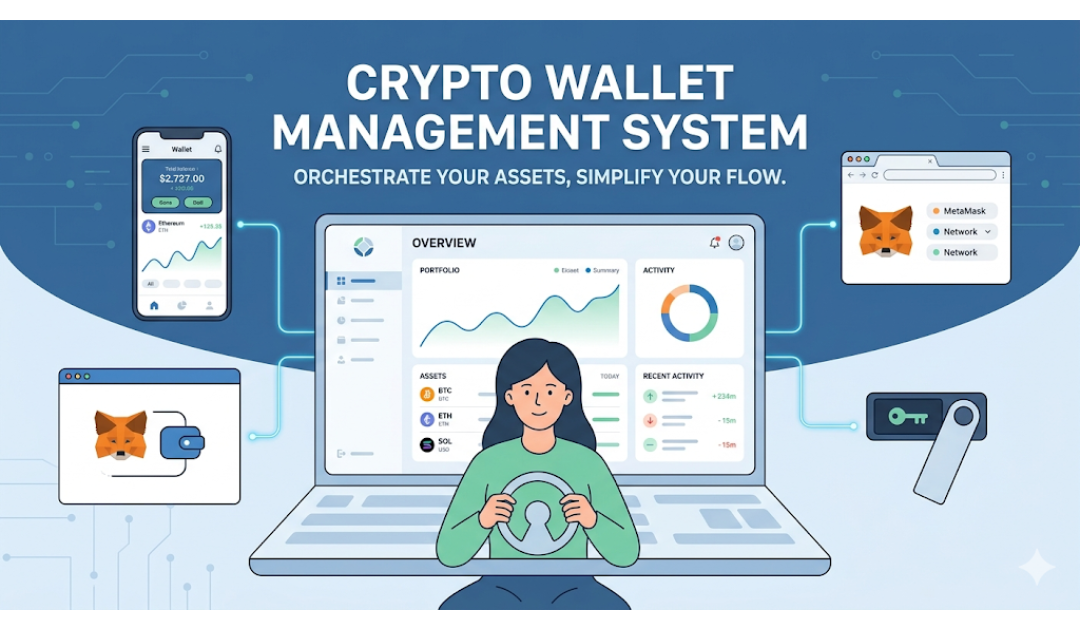
How to manage multiple crypto wallets effectively comes down to separating wallets by purpose, like long-term storage, trading, DeFi, or testing new platforms. Use a simple tracking system and review balances and permissions weekly so you stay organized and reduce security risks
As you explore DeFi, airdrops, and multiple blockchains, one wallet quickly turns into five or more. Suddenly, managing multiple crypto wallets starts to feel messy. You forget where funds are stored, lose track of transactions, and worry about security gaps.
This is not a small problem. According to Chainalysis, billions of dollars are lost every year due to hacks, scams, and poor wallet management practices. Many of these losses are not due to complex attacks but simple disorganization and weak security habits. That is where most users struggle.
If you are trying to organize crypto wallets, track assets across chains, and reduce risk without overcomplicating things, this guide is for you. You will learn a clear, structured crypto wallet management system. One that helps you stay organized, secure, and in control.
Why Do People Use Multiple Crypto Wallets?
People use multiple crypto wallets to reduce risk, separate different activities, and stay flexible across trading, investing, and DeFi. Managing multiple crypto wallets is about not putting all your funds in one place while keeping your crypto organized based on purpose.
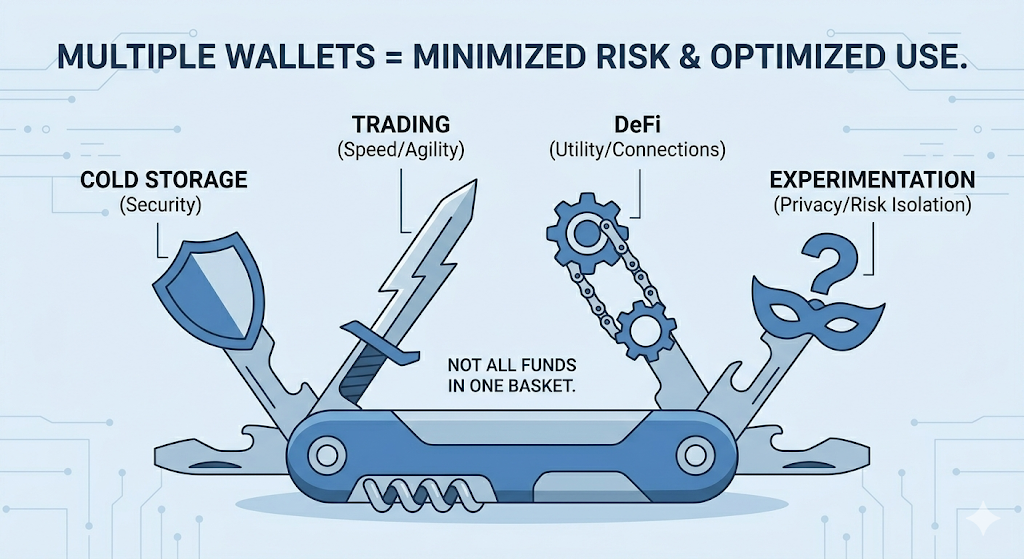
First, there is security diversification. Think of it like keeping cash in different places instead of one pocket. If one wallet gets compromised, you do not lose everything. This became very real after the collapse of FTX, where users lost access to funds held on a single platform.
Next is use-case separation. Most people do not use one wallet for everything. You might keep long-term holdings in a secure wallet and use another for active trading. Similarly, DeFi wallets are used to interact with decentralized apps, while hardware wallets stay untouched for safety.
Then comes privacy and experimentation. Some users create separate wallets for airdrops or new projects to avoid exposing their main funds to potentially unsafe platforms. This also helps when managing multiple wallets across blockchains, where different networks require different setups.
What Are the Types of Crypto Wallets?
To manage multiple crypto wallets efficiently, you need to understand the main wallet types and how they differ in security, control, and use. The key distinctions are between hot and cold wallets, custodial and non-custodial wallets, and advanced setups like multi-signature wallets.
Hot vs Cold Wallets
A hot wallet is connected to the internet, like apps such as MetaMask. It is fast and convenient but more exposed to hacks.
A cold wallet stays offline, where the private key is often stored in hardware wallets or on a piece of paper, making it far more secure but less convenient for daily use.
Most users combine both. They use hot wallets for daily transactions and cold wallets for long-term storage.
Custodial vs Non-Custodial Wallets
The choice between custodial and non-custodial wallets centers on a trade-off between convenience and sovereignty. In a custodial wallet, a third party like an exchange manages your private keys for you. This is ideal for beginners or active traders because it offers easy password recovery and instant liquidity, though it exposes you to “counterparty risk” where your funds could be frozen if the platform fails.
In contrast, non-custodial wallets give you total control over your private keys and immunity from exchange bankruptcies. This is the best use case for long-term investors and security-conscious users, but it places all responsibility on you; if you lose your seed phrase, your funds are gone forever. Ultimately, you must choose between the simplicity of a managed service and the absolute security of being your own bank.
Multi-Signature Wallets
Multi-signature (multisig) wallets act as a more secure, advanced version of a custodial setup. Instead of trusting a single person or entity with total control, a multisig wallet requires multiple unique private keys to authorize a single transaction. For example, requiring two out of three authorized users to sign off before any funds can move. This structure eliminates a single point of failure; even if one key is compromised or lost. This setup is ideal for businesses or groups that need shared oversight without giving any one individual absolute power over the treasury.
What Is the Ideal Strategy for Managing Multiple Crypto Wallets?
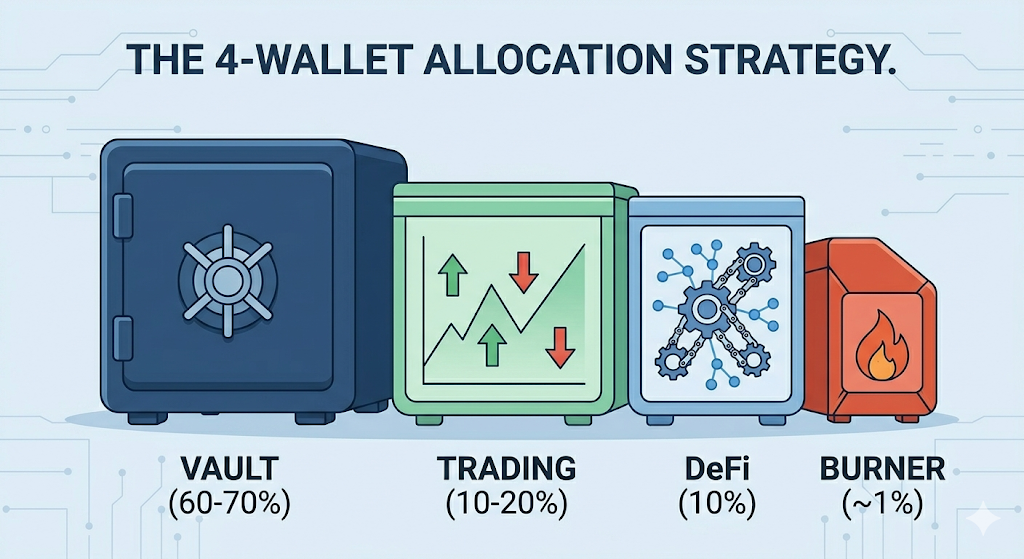
The most effective way to manage multiple wallets is to use a segmented structure that separates your funds by purpose and risk. Instead of keeping everything in one place, you should distribute your assets across a “4-wallet system” to ensure that a single mistake or hack doesn’t wipe you out.
In this setup, your vault acts as cold storage, kept offline and holding 60%–70% of your long-term wealth. Your trading wallet (10%–20%) stays online for quick exchange access, while a dedicated DeFi wallet (around 10%) is used specifically for staking and lending protocols. Finally, a burner wallet contains a tiny amount of funds for testing new platforms or claiming airdrops, acting as a shield for your primary assets.
While beginners can start with just two wallets, advanced users often manage four or more across different chains to maintain better control and flexibility. By diversifying where your private keys live, you aren’t just staying organized, you’re creating a professional security perimeter that keeps your main capital safe while you explore the more experimental sides of the ecosystem.
How to Manage Multiple Crypto Wallets Efficiently Step by Step?
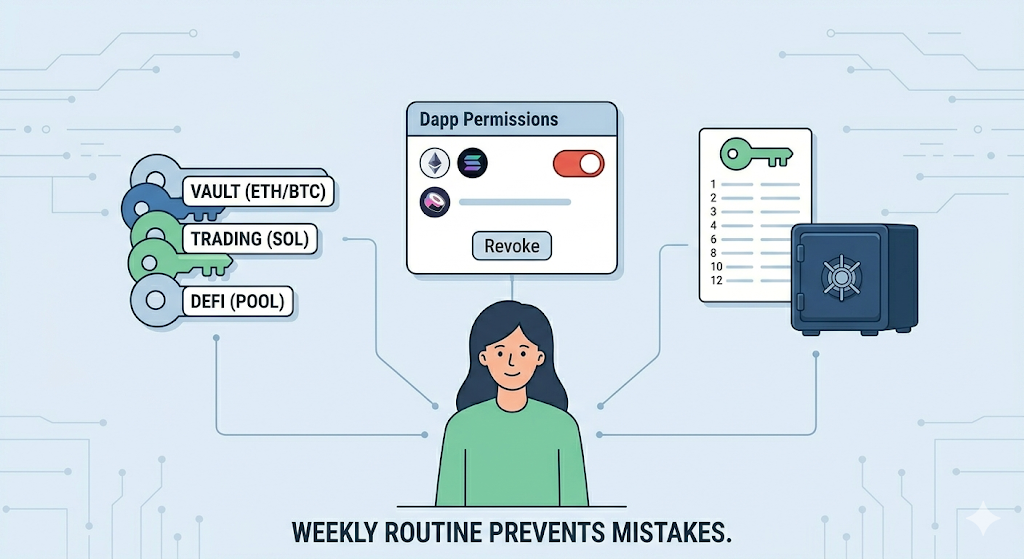
Start by labeling each wallet by its specific purpose (e.g., “Solana-NFTs”) to avoid address confusion. Next, maintain a tracking system, via spreadsheet or app, to log every wallet’s network and function. To streamline your view, use a portfolio tracker like ChainGlance to aggregate all balances and DeFi positions into a single dashboard. Finally, commit to a weekly routine: check your balances and, crucially, review token approvals to revoke any unnecessary permissions.
Step 1 – Label and Categorize Your Wallets
To label a wallet, you simply assign a “nickname” or “account name” within your app’s settings. Most non-custodial wallets (MetaMask, Ledger Live, Exodus) and major exchanges allow this. However, labels are local only; they won’t appear on the public blockchain, so your privacy remains intact.
Step 2 – Track Your Crypto Wallets Using a Portfolio Tracker
Managing multiple wallets manually is a recipe for burnout, so the pros use a combination of structured tracking and automated tools. At a minimum, you should maintain a log, whether a simple spreadsheet or a notes app, that tracks each wallet’s address, blockchain network, and specific purpose (like “Polygon-NFTs” or “Trading”).
To skip the manual math, use a portfolio tracker. Check out our in-depth list of best DeFi portfolio trackers to learn more.
These tools acts as a “command center” by aggregating all your balances, staked tokens, and DeFi positions into a single dashboard. Instead of logging into ten different apps, you get a real-time overview of your entire net worth across multiple chains.
Step 3 – Set a Weekly Wallet Management Routine
Set a weekly routine. Check balances, review token approvals, and scan for unusual activity. Token approvals are permissions you give to apps to access your funds, and they can be risky if left unchecked. Regular reviews help you avoid crypto hacks.
How Do DeFi Investors Manage Multiple Crypto Wallets Efficiently?
For DeFi investors, managing multiple wallets is less of a choice and more of a technical necessity. While a standard investor might just hold assets, DeFi users must juggle constant interactions with smart contracts across a fragmented landscape of Layer-1 and Layer-2 networks.
The unique challenge of DeFi lies in asset invisibility. Unlike simple tokens sitting in a wallet, DeFi capital is often “locked” in liquidity pools, lending protocols, or staking contracts. This means your balance might look like zero on a standard block explorer, even if you have thousands of dollars earning yield elsewhere. Furthermore, the risk is higher: you have to manage “token approvals”, permissions you’ve granted to specific protocols to move your funds, which can become massive security holes if a project is exploited.
To stay efficient, savvy investors use a siloed strategy: one wallet for stable lending, another for high-risk liquidity pools, and a “burner” for experimental airdrop farming. This isolates risk so a single protocol failure doesn’t drain your entire net worth. Because tracking these scattered positions manually is nearly impossible, using a unified dashboard like ChainGlance is essential. It pulls those “invisible” positions into one view, allowing you to monitor your total exposure and revoke risky permissions without hopping between a dozen different dApps.
What Common Mistakes Should You Avoid When Managing Multiple Crypto Wallets?
When managing multiple crypto wallets, most problems come from poor structure and weak security habits. Avoiding a few key mistakes can make your crypto wallet management much safer and easier to handle.
Over-Fragmentation and Poor Organization
Creating too many wallets without a clear wallet segmentation strategy leads to confusion. If you cannot track where your funds are, you increase the risk of losing control. Every wallet should have a defined purpose.
Losing Your Seed Phrase
Your seed phrase is your wallet’s master key. If you lose it, your funds are gone permanently. There is no recovery option. Always store it securely offline.
Unsafe Extensions and Hidden Risks
Fake browser extensions often mimic real wallets and steal data. Only install from trusted sources. Also, review token approvals regularly. These permissions allow apps to access your funds, and ignoring them can expose you to exploits and crypto hacks.
How Do You Track Multiple Crypto Wallets for Taxes and Accounting?
Tracking multiple crypto wallets for taxes can get messy real fast. Let’s say you’ve got a MetaMask wallet for DeFi, a Ledger hardware wallet where you keep your long-term Bitcoin holdings, and maybe a separate wallet you used for that NFT phase you went through.
Totally normal setup, except come tax season, things get messy fast.
Every trade you made, every time you swapped tokens, and every staking reward that landed in your wallet are all potentially taxable events. And they’re spread across three different wallets, on different blockchains, with hundreds of transactions between them. Now you’re sitting there trying to remember: what was ETH worth on the exact day I swapped it for that altcoin six months ago? Good luck piecing that together manually.
It gets even trickier when you factor in things like staking rewards, which are typically treated as income at the moment you receive them, while a token swap might trigger a capital gain or loss. Different rules, different calculations, all tangled up across multiple wallets. It’s genuinely a headache.
This is exactly where Bitcoin.tax comes in. It’s simple. You feed it your transaction history, and it aggregates everything, calculates your gains and losses, and spits out a clean tax report you can file instantly.
But you still need to get all that transaction data in there, from every wallet you own. If you’re managing multiple wallets, you’re probably already using a portfolio tracker to keep an eye on everything. But not every portfolio tracker has tax-reporting features. That’s where ChainGlance stands out. It generates importable files that you can drop directly into Bitcoin.tax, and it has everything it needs to build your full tax report.
FAQs
How Do You Recover Access If You Lose Track of One Wallet Among Many?
Losing an app or even a hardware device isn’t a “game over” as long as you have your seed phrase. Think of this phrase as the master key to your digital vault; those 12 or 24 words can regenerate your wallet on any compatible device. The real danger isn’t losing the app, it’s losing the backup or forgetting which phrase belongs to which wallet. To avoid a panic, keep a physical “map” (stored safely offline) that labels which phrase unlocks which account, without actually writing the secret words on the same piece of paper.
Does Using Multiple Wallets Make Tax Reporting More Inaccurate?
It definitely can if you’re tracking everything manually. Every time you move funds between your own wallets, it creates a “fragmented” history that can look like a sale or income to an untrained eye. However, accuracy isn’t about the number of wallets; it’s about how you consolidate the data. If you use a tracker like ChainGlance or crypto-specific tax software, these tools are designed to recognize transfers between your own accounts and only flag the events that actually matter to the tax man.
How Do You Decide When to Stop Creating New Wallets?
There is a tipping point where adding a new wallet stops protecting you and just starts creating more work. If you find yourself unable to clearly label, track, or audit a wallet within your weekly routine, you’ve probably hit your limit. A good rule of thumb: every new wallet should serve a unique purpose, like a dedicated airdrop “burner” or a long-term vault. If it doesn’t lower your risk or improve your organization, it’s just unnecessary complexity.