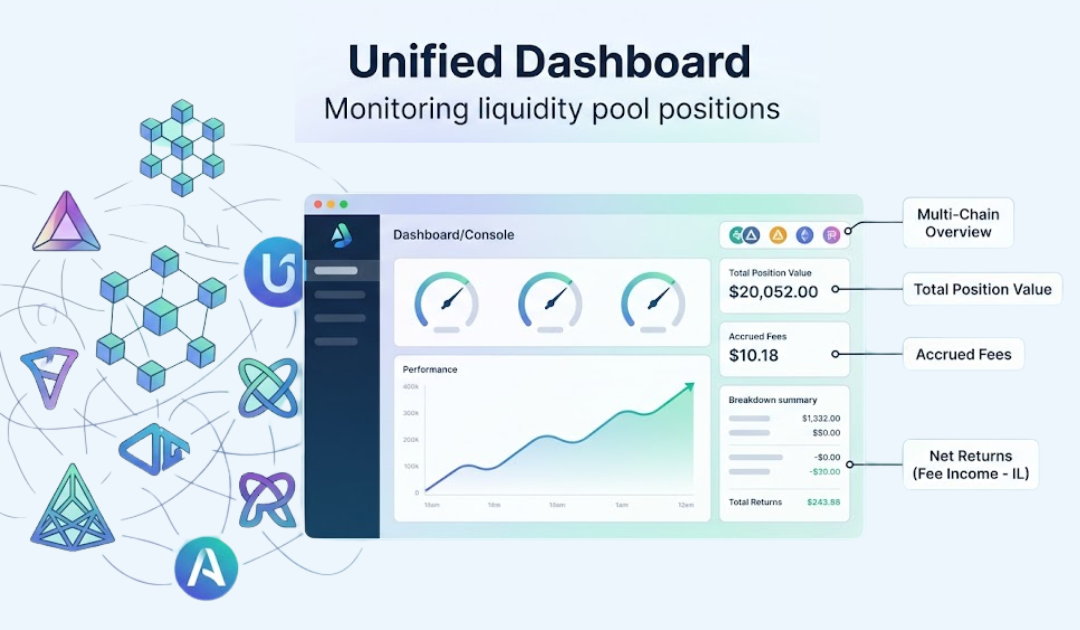
Monitoring liquidity pool position is the process of tracking your money in DeFi liquidity pools to see how much you’re earning, whether you’re making a profit, and whether risks like impermanent loss are affecting your returns. It helps liquidity providers understand how their investments are performing and when adjustments are needed.
If you monitor liquidity pool positions effectively, you’ll have a much clearer picture of whether your LP strategy is actually making money. The challenge is that tracking a liquidity pool position isn’t as simple as checking a token balance. Trading fees, reward incentives, impermanent loss, liquidity ranges, and multi-chain exposure can all affect your real returns.
As DeFi has grown, so has the complexity of managing LP positions. Today, DeFi protocols collectively hold more than $70 billion in total value locked (TVL), with liquidity spread across thousands of protocols and hundreds of blockchains.
That’s why monitoring has become a critical part of liquidity providing. In this guide, we’ll cover the best ways to monitor liquidity pool positions, from native protocol dashboards and DeFi portfolio trackers to advanced analytics platforms.
What Are Liquidity Pool Positions?
Liquidity pool positions are the funds you’ve deposited into a liquidity pool. They show how much of the pool belongs to you, how much in fees you’ve earned, and how your investment is performing over time.
To understand LP positions, it helps to first understand how liquidity pools work. In traditional exchanges, trades happen through an order book where buyers and sellers are matched with each other. In DeFi, there are no order books. Instead, trades happen through liquidity pools, which are collections of crypto tokens locked in a smart contract.
Rather than trading with another person, traders swap against the pool itself. The liquidity in these pools is provided by users, making it possible for exchanges to operate without a central intermediary or market maker.
When you add your own tokens to that pool, you become a liquidity provider, or LP. In return, you earn a share of the trading fees generated whenever people use the pool. Some protocols also offer extra rewards, such as governance tokens, to encourage more users to provide liquidity.
There are different types of liquidity pool positions. In traditional pools, your liquidity is spread across all possible prices automatically. With concentrated liquidity, introduced by Uniswap v3, you choose the price range where your funds will be active.
It’s a bit like opening a shop on the busiest street instead of every street in the city. This can help you earn more fees from the same amount of capital, but it also means you’ll need to keep a closer eye on your position as market prices change.
Why Does Monitoring LP Positions Matter?
Monitoring liquidity pool positions helps you understand whether your liquidity is actually generating a profit.
By tracking your positions regularly, you can monitor fee earnings, measure impermanent loss, manage liquidity ranges, and evaluate performance across different protocols and blockchains. This gives you a clearer picture of how your capital is performing and helps you make better investment decisions.
Many liquidity providers focus on the fees they’re earning, but fees only tell part of the story. A position can generate steady fee income while still underperforming overall if changes in token prices reduce the value of your holdings. This is known as impermanent loss, which is the difference between holding tokens in a liquidity pool and simply holding them in your wallet.
Monitoring becomes even more important for concentrated liquidity positions. With concentrated liquidity, you choose the price range where your funds will be active. If the market moves outside that range, your liquidity stops earning fees until you adjust the position.
As your DeFi activity grows, tracking everything manually becomes more difficult. Liquidity spread across multiple protocols, chains, and pools can quickly become hard to manage. Regular monitoring helps you spot underperforming positions early, compare opportunities, and decide where your capital can be used most effectively.
Method 1: Monitor Liquidity Pool Positions with Native Protocol Dashboards
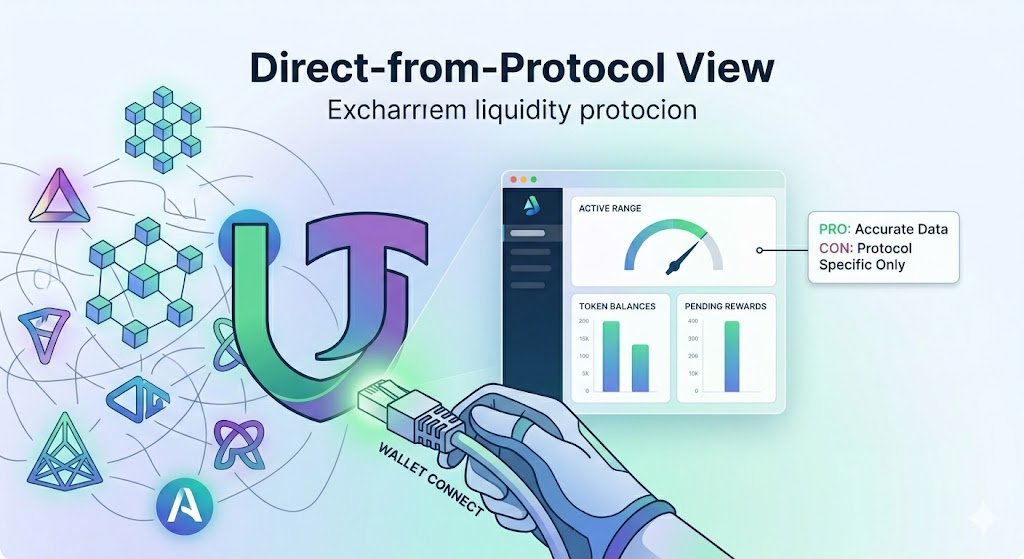
Native protocol dashboards are often the simplest way to monitor liquidity pool positions because they show information directly from the protocol where your funds are deposited, making it easy to track performance, fees, and rewards in one place.
Which Protocols Offer Native Dashboards?
Most major DeFi protocols have their own dashboard for liquidity providers. Platforms like Uniswap, Aerodrome, Raydium, and Trader Joe let you connect your wallet and view your LP positions directly from the protocol.
These dashboards usually show your position value, token balances, earned fees, and any reward tokens you’ve accumulated. If you’re using concentrated liquidity, they’ll often show your chosen price range and whether your liquidity is currently active. Since concentrated liquidity only earns fees within a specific price range, this information is particularly useful to keep an eye on.
What Are the Pros and Cons of Monitoring LP Positions on Native Dashboards?
The biggest advantage of native dashboards is that the data comes directly from the protocol itself. You can quickly check your position, see how much you’ve earned, and make changes without leaving the platform.
The downside is that they only show positions on that specific protocol. If you’re providing liquidity on multiple platforms or chains, you’ll need to jump between several dashboards to get a complete picture of your portfolio. As your DeFi activity grows, that can become difficult to manage.
Method 2: Monitor Liquidity Pool Positions Using DeFi Portfolio Trackers
DeFi portfolio trackers, like ChainGlance, are one of the easiest ways to monitor liquidity pool positions, especially if you’re providing liquidity across multiple protocols and blockchains. Instead of checking several dashboards throughout the day, these tools pull everything into one place, giving you a single view of your DeFi portfolio.
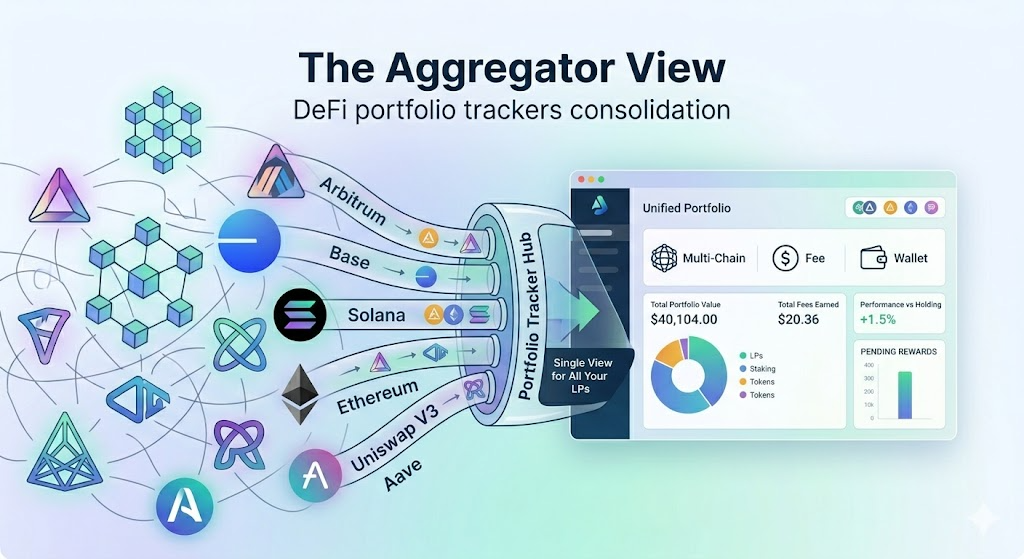
Most portfolio trackers connect directly to your wallet and automatically detect LP positions, staked assets, tokens, and other DeFi holdings. This means you can see what’s happening across your portfolio without constantly switching between protocols. For active LPs, that convenience can save a significant amount of time.
Another major benefit is multi-chain support. If you have liquidity on Ethereum, Arbitrum, Base, Solana, or other networks, a portfolio tracker can help you monitor everything from one dashboard rather than juggling multiple platforms.
What Can You Track?
Beyond portfolio value, most trackers show metrics like earned fees, farming rewards, and changes in position value over time. This makes it easier to spot underperforming positions and understand which pools are generating the best returns.
While they may not offer the deep analytics of dedicated LP tools, portfolio trackers are often the best balance between simplicity and visibility for most DeFi users.
Which DeFi Portfolio Trackers Are Best for Monitoring LP Positions?
Several portfolio trackers are popular among liquidity providers, but ChainGlance stands out as one of the best all-around options. It’s completely read-only, making it a privacy-focused choice, while still offering powerful multi-chain portfolio tracking that remains easy to use for both beginners and experienced DeFi users. It also integrates directly with Bitcoin.Tax, helping automate transaction imports and tax reporting. Plus, its free tier is sufficient for many users getting started in DeFi.
DeBank and Zerion are also solid options. DeBank is known for its broad protocol coverage and wallet insights, while Zerion offers a clean, beginner-friendly experience.
For a more detailed comparison, check out our in-depth guide, where we review each platform in depth.
Method 3: Monitor Liquidity Pool Positions Using Dedicated LP Analytics Tools
If you want more than a basic overview of your LP positions, dedicated LP analytics tools can help. Unlike portfolio trackers, which focus on your overall portfolio, these platforms are built specifically for analyzing liquidity pool performance.
What Can LP Analytics Tools Track?
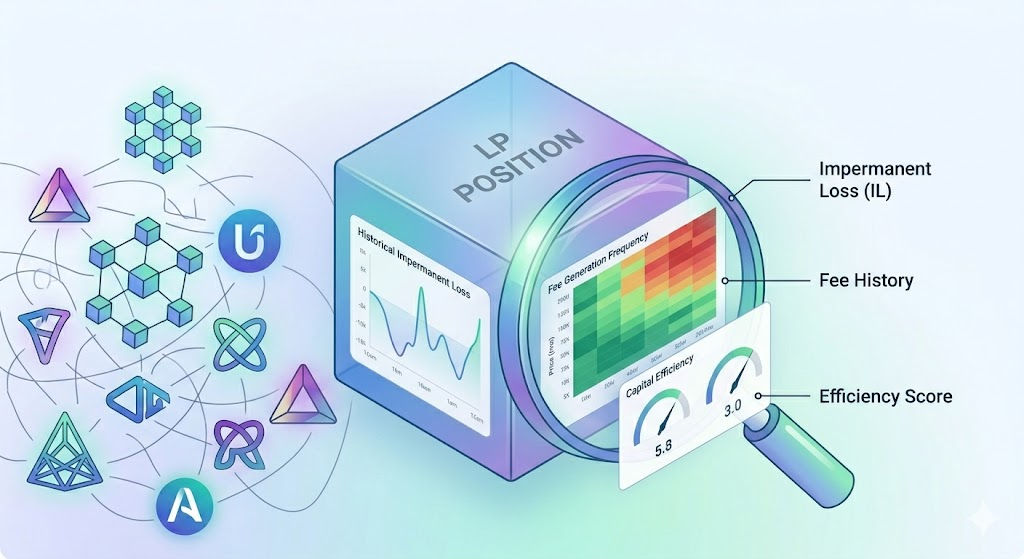
LP analytics tools typically track metrics like fee income, impermanent loss, and overall position performance. Impermanent loss is the reduction in value that can happen when the tokens in a pool change in price compared to simply holding them in your wallet.
For concentrated liquidity positions, these tools can also measure capital efficiency. In other words, they help you understand whether your chosen price range is generating enough fees to make the position worthwhile.
Which LP Analytics Tools Are Popular?
APY Vision is popular for tracking impermanent loss and LP profitability over time. Revert Finance focuses on concentrated liquidity positions and provides detailed insights into fee earnings and position performance. Gamma Strategies combines analytics with automated liquidity management tools.
For active LPs, these platforms can reveal insights that standard dashboards often miss, making it easier to spot underperforming positions and make better liquidity management decisions.
Method 4: Monitor Liquidity Pool Positions Manually
Yes, you can monitor liquidity pool positions manually using spreadsheets and transaction records. While it takes more work, it gives you complete control over how you track performance and analyze your LP positions. The biggest advantage is that it’s completely free.
Most users export transaction data from wallets, protocols, or block explorers and record it in a spreadsheet. From there, they can track deposits, withdrawals, earned fees, rewards, and changes in position value over time.
What Are the Pros and Cons?
The biggest benefit of manual tracking is flexibility. You can build custom reports, track the metrics that matter most to your strategy, and get a deeper understanding of how your LP positions perform.
The downside is that it doesn’t scale well. If you’re providing liquidity across multiple chains and protocols, keeping spreadsheets up to date can quickly become time-consuming. It’s also easier to make mistakes when calculations and data entry are done manually. For most active LPs, automated tracking tools are usually the more practical option.
What Metrics Should Liquidity Providers Monitor?
Liquidity providers should monitor several key metrics to understand whether their positions are profitable and being used efficiently. Tracking these metrics regularly can help you identify risks, improve returns, and make better decisions about where to allocate capital.
Impermanent Loss
Impermanent loss occurs when the price of the tokens in a liquidity pool changes after you deposit them. As the pool automatically rebalances the assets, you can end up with a lower value than if you had simply held the tokens in your wallet. Measuring it is important because it can significantly reduce your overall LP returns.
Fee Income
Fee income refers to the trading fees your position earns whenever users swap assets in the pool. Since fees are often the primary source of LP returns, they should be monitored closely.
APR and APY
APR and APY estimate the potential return on a position. APR does not account for compounding, while APY includes it, making it useful when comparing different opportunities.
Pool Utilization
Pool utilization shows how actively traders are using a liquidity pool. Higher trading activity generally means more fee-generating opportunities for liquidity providers.
Liquidity Efficiency
Liquidity efficiency measures how effectively your capital is generating fees. This metric is especially important for concentrated liquidity positions.
Active vs Inactive Liquidity
Active liquidity is currently earning fees, while inactive liquidity is not. If the market moves outside your selected price range, your liquidity may become inactive until the position is adjusted.
What Risks Should Liquidity Providers Monitor?
Providing liquidity can generate fees and rewards, but it also exposes your capital to several risks. Understanding these risks can help you evaluate whether a position is worth holding and avoid surprises that can impact your returns.
Impermanent Loss
Impermanent loss occurs when the price of the tokens in a liquidity pool changes after you deposit them. As the pool automatically rebalances the assets, you can end up with a lower value than if you had simply held the tokens in your wallet. Measuring impermanent loss is important because it can significantly reduce your overall LP returns.
Smart Contract Risk
Liquidity pools rely on smart contracts. If there is a bug or security flaw in the code, attackers may be able to exploit it and put user funds at risk.
While no protocol is completely risk-free, you can reduce this risk by using established platforms, checking whether the protocol has undergone reputable smart contract audits, and reviewing its security track record before depositing funds.
Stablecoin Depegs
A stablecoin depeg happens when a stablecoin loses its intended value, such as falling below $1. A well-known example is the collapse of UST in 2022, which caused major losses for liquidity providers and investors.
While large depegs are uncommon among established stablecoins, they can still happen. To reduce this risk, many LPs stick to reputable stablecoins and avoid concentrating too much capital in a single stablecoin pool.
Rug Pulls
Rug pulls occur when a project’s team abandons or exploits a protocol, often leaving liquidity providers with worthless or heavily depreciated assets.
To reduce this risk, avoid anonymous or newly launched projects with little track record. Before providing liquidity, review the team, tokenomics, liquidity lock status, smart contract audits, and overall community reputation.
MEV Attacks
MEV, or Maximum Extractable Value, refers to strategies where bots profit by reordering or front-running transactions. This can result in worse prices and lower returns for regular users.
While MEV cannot be avoided entirely, using established protocols and MEV-protected transaction services can help reduce your exposure.
Protocol Exploits
Even established DeFi protocols can suffer exploits due to smart contract vulnerabilities or other security weaknesses. These incidents can result in stolen funds or significant losses for liquidity providers.
Monitoring protocol security, recent incidents, and audit reports can help you identify risks before they become major problems.
How Should You Choose the Best LP Monitoring Method?
The best monitoring method depends on how much liquidity you manage and how active you are in DeFi. As your portfolio becomes more complex, you’ll usually need more advanced tools.
Beginners
If you’re new to liquidity providing, native protocol dashboards are often enough since you probably don’t have dozens of active positions across many platforms. They make it easy to track positions, fees, and rewards without learning additional tools.
Active LPs
For users managing several positions or if their liquidity is spread across different blockchains and protocols, DeFi portfolio trackers, like Chain Glance, provide an overall best overview by bringing assets, rewards, and LP positions into a single dashboard and many more features useful beyond just liquidity pool positions.
Advanced DeFi Investors
Advanced users often combine DeFi portfolio trackers with detailed LP analytics platforms. This provides deeper insights into liquidity flows, market trends, and position performance, helping them make more data-driven decisions.
Frequently Asked Questions
How Often Should I Check My LP Positions?
It depends on your strategy. Long-term liquidity providers may only need to check positions a few times a week, while active LPs, especially those using concentrated liquidity, often monitor positions daily to ensure they remain productive.
Can I Monitor LP Positions Without Connecting My Wallet?
Yes. Many analytics platforms allow users to track positions by entering a wallet address. This lets you monitor LP positions without granting wallet permissions or signing transactions.
Are LP Monitoring Tools Free to Use?
Many LP monitoring tools offer free versions with basic tracking features. However, advanced analytics such as detailed impermanent loss calculations, historical performance reports, and premium dashboards may require a paid subscription depending on the platform.
Why Do Uniswap v3 LP Positions Need More Monitoring?
Uniswap v3 uses concentrated liquidity, which means you choose the price range where your liquidity will be active. This can help you earn more fees with the same amount of capital, but it also requires more attention. If the market price moves outside your chosen range, your liquidity stops earning fees until you adjust the position. That’s why many Uniswap v3 LPs regularly monitor and rebalance their positions to keep them active.