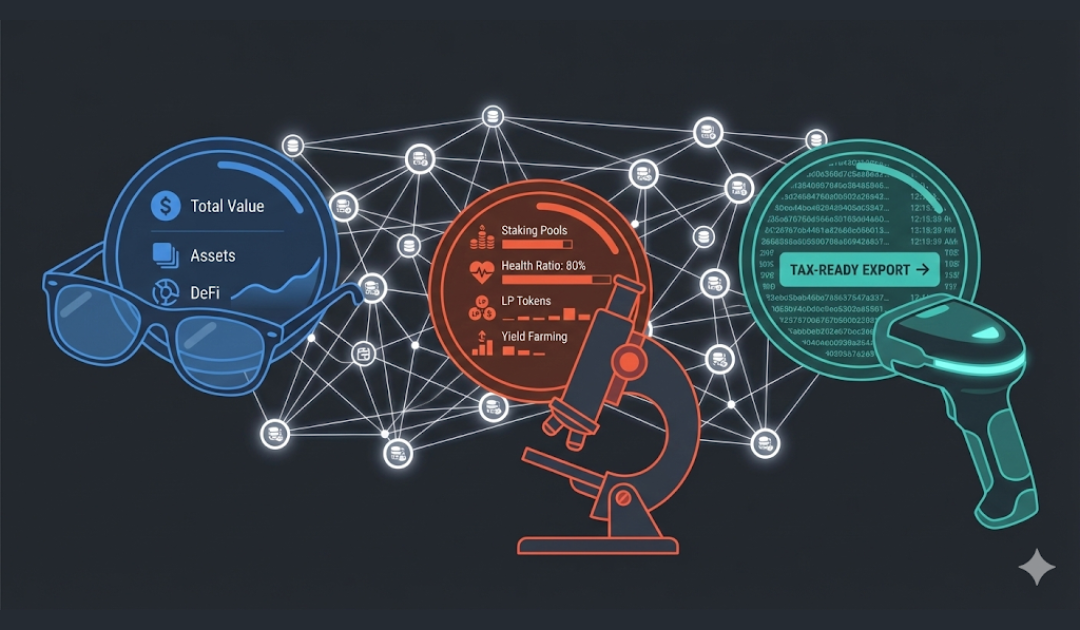
Zerion offers a clean, beginner-friendly dashboard for tokens, NFTs, and basic DeFi positions; DeBank delivers the deepest analytics and protocol-level insights for power users managing complex multi-chain portfolios; and ChainGlance sits in between, combining detailed on-chain data and real-time tracking with structured insights that are easier to navigate than DeBank’s analytics.
Zerion vs DeBank vs ChainGlance is a common comparison among DeFi users who want a reliable way to track assets across multiple blockchains. With DeFi spread across Ethereum, L2s, and dozens of emerging chains, keeping track of tokens, NFTs, yield positions, and PnL has become confusing and time-consuming.
That’s exactly the problem DeFi portfolio trackers solve. Instead of manually checking wallets, protocols, and block explorers, which is prone to costly mistakes, an on-chain portfolio tracker brings everything into one dashboard. This matters more than ever. As of mid-2025, global DeFi TVL ranges between roughly $115 billion and $150 billion across chains, highlighting the scale and complexity of multi-chain DeFi ecosystems. Yet most centralized portfolio apps still fail to capture real DeFi positions like liquidity pools or staking rewards.
But not all trackers are built the same. Some focus on simplicity, others on analytics, and some on real-time data. In this guide, we break down Zerion vs DeBank vs ChainGlance, explain how they differ from centralized apps, and help you choose the best DeFi portfolio tracker based on your goals, experience level, and on-chain behavior.
What Are Zerion, DeBank, and ChainGlance?
Zerion, DeBank, and ChainGlance are all DeFi portfolio trackers, but they’re built for different kinds of users. Zerion is easiest to use, DeBank offers the deepest DeFi analytics, and ChainGlance stands out for real-time on-chain data and detailed insights.
What is Zerion and how does it work?
Zerion is a popular DeFi portfolio tracker launched in 2019 by Zerion Inc. It connects directly to your wallet and shows your tokens, NFTs, DeFi positions, and transaction history in one place.
Zerion is best known for its clean UI and beginner-friendly DeFi dashboard. Think of it as a “crypto banking app” for DeFi. It works well as a crypto portfolio tracker for users who want simplicity without sacrificing multi-chain coverage.
What is DeBank and why is it popular among power users?
DeBank launched in 2020 and was built by a team deeply embedded in DeFi research and analytics. It became popular because it goes far beyond basic tracking.
DeBank provides detailed protocol data, wallet rankings, social features, and in-depth views of DeFi positions. For many traders, it’s considered the go-to on-chain portfolio tracker and one of the most powerful DeFi analytics tools.
If Zerion is a sleek dashboard, DeBank is a full control panel for serious DeFi users.
What is ChainGlance and how is it different?
ChainGlance is a Web3 portfolio tracker that focuses on real-time on-chain data and advanced analytics. It helps you see detailed transactions, track assets across multiple chains, and understand wallet behavior more clearly.
What makes ChainGlance different is its data depth. It offers deeper insights than Zerion but feels more structured and less overwhelming than DeBank, making it a strong DeFi dashboard for users who want powerful analytics without too much complexity.
Zerion vs DeBank vs ChainGlance: In-Depth Comparison
Zerion, DeBank, and ChainGlance all function as a DeFi portfolio tracker, but they differ in depth, usability, and analytics power. In this section, we break down Zerion vs DeBank vs ChainGlance across features, on-chain data, UX, security, and pricing.
| Feature | Zerion | DeBank | ChainGlance |
|---|---|---|---|
| Best For | Beginners / Casual Users | Power Users / Farmers | Data-focused / Tax Prep |
| Main Strength | Clean UI / Mobile App | Deepest Protocol Data | Real-time / Tax Export |
| Chain Support | 50+ Chains | 95+ Chains | Multi-chain Analytics |
| Unique Edge | Built-in Swap/Bridge | Social Features / Whale Tracking | Bitcoin.Tax Integration |
| Pricing | Free (Premium: $99/yr) | Free (Add-ons: ~$15/mo) | Free (Advanced: Paid) |
Features
When it comes to tracking multiple wallets, DeBank is the most powerful. It can show assets and DeFi positions from several wallets and blockchains in one place. Zerion is simpler and more visual, which makes it a smooth crypto portfolio tracker for everyday users. ChainGlance goes deeper by showing how wallets move assets, interact with protocols, and change positions over time, which helps users understand how experienced traders manage complex portfolios.
In terms of blockchain and protocol coverage, DeBank supports the widest range of networks, with coverage of around 95 blockchains, including Ethereum, Polygon, BNB Chain, Fantom, and multiple Layer-2 ecosystems. Zerion supports 50+ chains, focusing mainly on major networks like Ethereum, Solana, and popular EVM chains. ChainGlance places more emphasis on multi-chain analytics and faster data updates rather than sheer network count.
For DeFi positions, NFTs, and tokens, Zerion stands out for its clean and easy-to-read design. DeBank provides more detailed information on staking, lending, and liquidity pools. ChainGlance also stands out because it lets users export their full on-chain transaction history and import it directly into Bitcoin.Tax. This makes DeFi tax reporting much easier, especially for users managing multiple wallets and protocols. Instead of manually compiling data, users can generate tax-ready records in a few clicks.
On-Chain Data and Analytics Coverage
DeBank offers the deepest insights into DeFi activity. It shows how your assets are spread across protocols, how risky your positions are, and how your portfolio has evolved over time. ChainGlance offers deeper insights into wallet activity, such as detailed transaction history, cross-chain asset movement, and exportable data for tax reporting. Zerion, on the other hand, focuses on simple summaries like portfolio value, token balances, and DeFi positions, making it easier to understand but less detailed.
ChainGlance stands out with faster updates and near real-time data, which is useful for active traders. DeBank balances speed with accuracy, while Zerion focuses on stable and readable data rather than constant updates.
When it comes to detail, ChainGlance gives the most in-depth view of transactions and portfolio performance. DeBank offers a good balance between depth and usability. Zerion keeps things simple, which makes it a better DeFi dashboard for beginners than a heavy analytics tool.
Read our full guide on how to track multiple DeFi wallets for to learn more.
User-Friendliness and UI/UX
Zerion is the easiest platform to use. Its design is clean, minimal, and intuitive, which makes it ideal for people new to DeFi. For many users, it feels like the most approachable DeFi dashboard.
DeBank is built for advanced users. It shows a lot of information at once, which appeals to traders who want deeper insights. ChainGlance sits in between, it offers detailed data but in a more structured way than DeBank, making it easier to navigate.
Overall, Zerion focuses on simplicity, DeBank focuses on depth, and ChainGlance focuses on precision.
Security and Privacy
All three tools are non-custodial and do not require private keys. You usually just paste a wallet address or connect in read-only mode, which lowers security risks.
Zerion offers a clean and privacy-friendly experience without social features. DeBank uses public wallet data and adds social elements, which some users find useful and others find intrusive. ChainGlance focuses mainly on blockchain data, which makes it appealing to users who prefer analytics over social features.
In terms of credibility, Zerion has been active since 2019 and is backed by well-known Web3 investors such as Placeholder, Blockchain Capital, Gnosis, Fenbushi Capital, and Digital Currency Group (DCG). DeBank has earned strong trust in the DeFi community since 2020. ChainGlance is newer but is emerging as a strong Zerion and DeBank alternative for data-focused users. Its credibility comes from the team behind Bitcoin.Tax, one of the oldest and most trusted crypto tax platforms.
Pricing
Zerion and DeBank are free for most core features, making them easy to use as everyday Web3 portfolio trackers. Zerion’s Premium plan starts at $99 per year for one wallet, unlocking advanced PnL insights and data exports.
DeBank also offers free tracking, but some advanced features are paid, with subscriptions costing around $15 per month, depending on the tools used. ChainGlance provides free portfolio tracking as well, but advanced analytics and professional features may be limited in the free version.
Overall, Zerion is the most affordable upgrade, DeBank charges for deeper analytics, and ChainGlance balances free tracking with paid advanced tools.
What Are the Pros and Cons of Zerion vs DeBank vs ChainGlance?
Zerion wins on simplicity, DeBank dominates depth, and ChainGlance excels in analytics, but each tool has clear trade-offs.
Zerion
Zerion’s biggest strength is usability. It feels intuitive, visual, and easy to navigate, which makes it a strong DeFi portfolio tracker for beginners. It also works well as a clean crypto portfolio tracker for tokens, NFTs, and basic DeFi positions.
However, Zerion lacks deep protocol-level insights and advanced metrics. Compared to DeBank or ChainGlance, its analytics can feel shallow for power users.
DeBank
DeBank outperforms competitors in data depth. It offers rich protocol-level insights, wallet discovery, and detailed DeFi positions, making it one of the most powerful on-chain portfolio trackers and a go-to DeFi analytics tool.
But its interface can feel cluttered and overwhelming. For beginners, DeBank often feels like reading a technical dashboard rather than a simple DeFi dashboard.
ChainGlance
ChainGlance’s strength lies in real-time analytics and granular performance metrics. It’s ideal for users who want precise portfolio tracking, detailed PnL, and structured insights across chains, almost like a data-first Web3 portfolio tracker.
ChainGlance’s biggest strength is its integration with Bitcoin.Tax, which makes it especially useful for exporting DeFi transactions and simplifying crypto tax reporting across multiple wallets and chains. Its main limitation is that it doesn’t offer analytics as deep as DeBank and lacks social features like wallet discovery or rankings, which some advanced users may find valuable.
Check out our full list of best DeFi portfolio trackers for more.
Which Tool Is Best for Different Types of Users?
Zerion is best for beginners and casual DeFi users with a few wallets and simple activity like holding tokens, staking, or using basic lending platforms. Its interface is clean and visual, so you can track tokens, NFTs, and DeFi positions without feeling overwhelmed. The trade-off is depth, it doesn’t fully capture complex strategies or detailed protocol data.
DeBank is ideal for power users who manage multiple wallets and actively use DeFi apps, liquidity pools, and yield farming strategies across chains. It offers deep protocol-level insights and detailed views of positions, making it feel more like a professional control panel than a basic crypto portfolio tracker. However, its interface can feel crowded and harder to learn.
ChainGlance works best for intermediate and data-focused users who want more detail than Zerion but less complexity than DeBank. It offers accurate performance tracking, multi-chain insights, and strong Bitcoin.Tax integration for easier DeFi tax reporting. Its analytics are not as deep as DeBank’s, but it’s a strong choice for users who care about clear performance data without overwhelming complexity.
Frequently Asked Questions
Can DeFi portfolio trackers detect scams or risky protocols?
Most tools like Zerion, DeBank, and ChainGlance don’t directly flag scams. But DeBank sometimes shows protocol risk signals and unusual activity. ChainGlance can help you spot suspicious patterns using transaction data.
Do these tools support hardware wallets like Ledger or Trezor?
Yes. Since they track public wallet addresses, you can monitor Ledger or Trezor wallets without exposing private keys. This makes them safe options for tracking assets with an on-chain portfolio tracker without compromising security.
Can I use one dashboard to track both DeFi and CEX holdings?
Partially. Zerion and DeBank mainly focus on DeFi and on-chain assets. Some integrations allow limited CEX tracking, but they are not full replacements for centralized portfolio apps. That’s why many users combine a crypto portfolio tracker with separate CEX tools.