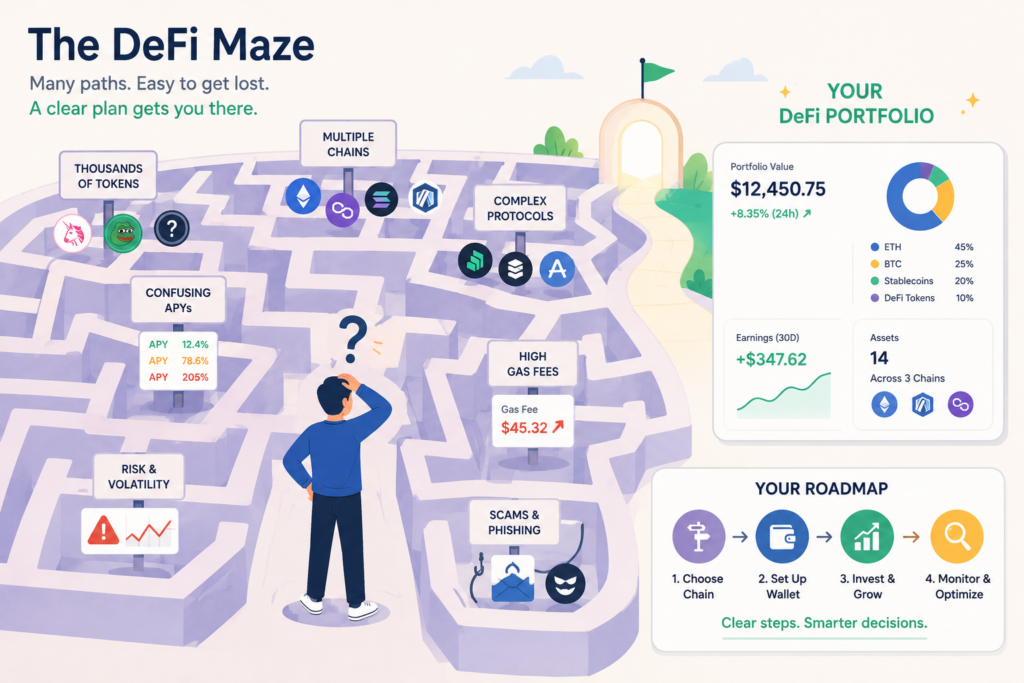
If you want to build your first DeFi portfolio, and it feels too overwhelming, especially if you’re new to decentralized finance. With thousands of tokens, dozens of blockchains, and new DeFi apps launching all the time, it’s easy to wonder where to invest, how much risk to take, and which projects are actually worth considering.
If that sounds familiar, you’re not alone. Decentralized finance (DeFi) has grown into a market with more than $70 billion in Total Value Locked (TVL) across lending platforms, decentralized exchanges, and staking protocols. That growth has created plenty of opportunities, but it has also made it harder for beginners to separate solid investment strategies from unnecessary risks.
This guide shows you how to build your first DeFi portfolio step by step. You’ll learn how to choose the right blockchain, set up a secure wallet, diversify your investments, manage risk, and put your assets to work.
What Is a DeFi Portfolio?
A portfolio is simply a collection of investments you own. In traditional finance, that could include stocks, bonds, ETFs, or mutual funds. Instead of putting all your money into a single investment, you spread it across different assets to balance risk and improve your chances of earning steady returns over time.
A DeFi portfolio follows the same idea, except your investments are in decentralized finance (DeFi) instead of traditional financial products. Rather than using banks or brokers, you use blockchain-based applications to lend, stake, provide liquidity, and invest directly from your crypto wallet.
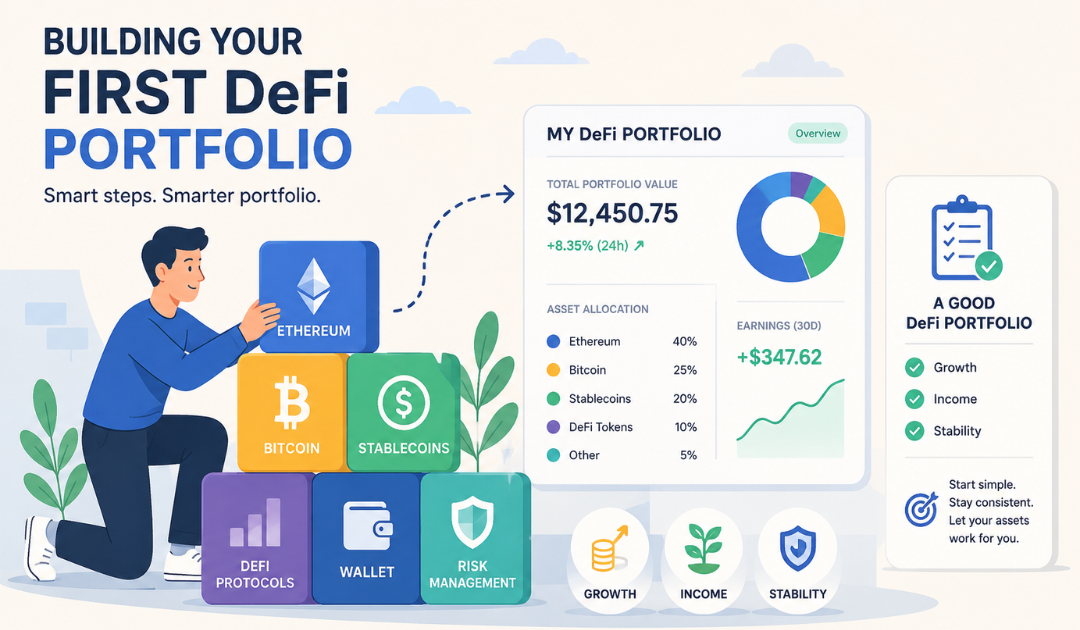
A typical DeFi portfolio might include assets like Ethereum, Bitcoin, stablecoins, and tokens from established DeFi protocols. Each asset plays a different role. Some are focused on long-term growth, while others generate passive income or help reduce volatility.
The goal isn’t just to own crypto, it’s to put your assets to work. Instead of sitting idle in your wallet, they can earn staking rewards, lending interest, or other on-chain yield. And just like any investment portfolio, spreading your money across different assets and strategies can help reduce risk if one investment underperforms.
How to Build Your First DeFi Portfolio: Step-by-Step Guide
Building your first DeFi portfolio doesn’t have to be complicated. The easiest way to approach it is one step at a time. Start by deciding what you want to achieve and how much risk you’re comfortable taking. Then choose a blockchain, set up a secure wallet, learn the main DeFi strategies, and build a portfolio that matches your goals. Once everything is in place, review your investments regularly and rebalance them when needed.
Following these steps won’t remove all the risks that come with DeFi investing, but it will give you a strong foundation and help you avoid many of the mistakes beginners make.
Step 1: Decide Your Investment Goals and Risk Tolerance
Before you invest a single dollar, ask yourself one simple question: What do you want your portfolio to do?
Some people are investing for long-term growth, while others want to earn passive income through staking or crypto lending. Your answer will influence everything from the assets you buy to the DeFi strategies you use.
Next, think about how much risk you’re comfortable with. DeFi can offer attractive returns, but it’s still a young industry. Prices can be volatile, and risks like smart contract bugs or protocol failures are always worth keeping in mind.
A good rule is to start with an amount you can afford to lose. For some people, that might be $100. For others, it could be much more. There’s no right number because everyone’s financial situation is different.
Most importantly, don’t feel like you need to buy every trending token or chase the highest APYs. A simple DeFi portfolio for beginners built around quality assets is usually a much better long-term strategy. As your knowledge grows, you can gradually expand your portfolio and take on more risk if it makes sense.
Step 2: Choose the Right Blockchain
The next decision is choosing where you’ll invest. The blockchain you use affects the DeFi protocols you can access, the gas fees you pay, and your overall experience.
For most beginners, Ethereum is the safest place to start. It has the largest DeFi ecosystem, the highest Total Value Locked (TVL), and some of the most established protocols in crypto. The trade-off is that transaction fees can become expensive when the network is busy.
If keeping costs low is more important, Layer 2 networks like Arbitrum and Base are excellent alternatives. They work alongside Ethereum, so you can use many of the same DeFi applications while paying much lower transaction fees. Both have also become popular choices for beginners because they’re easy to use and continue to attract new projects.
Polygon is another solid option. It’s known for very low fees and a large ecosystem, making it a practical choice if you’re investing smaller amounts.
There’s no single “best” blockchain. If security and ecosystem size matter most, Ethereum is hard to beat. If you’d rather save on fees, Arbitrum, Base, or Polygon may be a better fit. Choose the one that matches your budget and how you plan to use DeFi.
Step 3: Set Up a Secure DeFi Wallet
Before you can start using DeFi, you’ll need a wallet. Think of it as your gateway to decentralized finance. It’s where you’ll store your crypto and connect to DeFi applications.
For most beginners, a non-custodial wallet is the best choice because it gives you full control over your funds. Unlike an exchange account, you’re the only person who has access to your wallet.
You’ll generally come across two types of wallets. Hot wallets stay connected to the internet, making them convenient for everyday use. Popular options include MetaMask, Rabby, Coinbase Wallet, and Trust Wallet. Hardware wallets, on the other hand, store your crypto offline. They’re much more secure, especially if you’re investing larger amounts, although they’re slightly less convenient for frequent transactions.
Whichever wallet you choose, security should always come first. Write down your seed phrase and store it somewhere safe offline. Never save it to cloud storage, email it to yourself, or share it with anyone.
It’s also worth developing a few good habits early on. Always double-check website URLs before connecting your wallet, review token approvals before signing transactions, and remember that no legitimate project will ever ask for your recovery phrase. If someone does, it’s almost certainly a scam.
Good wallet security might not seem exciting, but it’s one of the most important parts of building a DeFi portfolio. A few simple precautions can protect your investments far better than chasing higher returns ever will.
Step 4: Put Your Assets to Work in DeFi
This is where decentralized finance (DeFi) starts to look different from traditional investing.
If you buy stocks, you usually wait for their price to go up. In DeFi, your crypto doesn’t have to sit idle in your wallet. Depending on the assets you own, you can use them to earn passive income while still holding them.
Here are some of the most common strategies beginners start with:
- Staking: If you hold ETH or another Proof-of-Stake cryptocurrency, you can stake it to help secure the network and earn staking rewards in return. It’s one of the simplest ways to generate passive income in DeFi.
- Crypto lending: If you own stablecoins, you can lend them through established DeFi protocols. Borrowers pay interest to access those funds, and part of that interest is passed on to you.
- Yield farming: This involves providing liquidity to liquidity pools in exchange for trading fees and token rewards. While the returns can be higher, so are the risks. As a beginner, it’s usually better to understand staking and lending before exploring yield farming.
Whatever strategy you choose, stick to well-established protocols with a long track record and high Total Value Locked (TVL). They aren’t risk-free, but they’re generally considered safer than newer projects.
It’s also worth knowing what to avoid early on. Leveraged yield farming can magnify both gains and losses, complex liquidity pools can expose you to impermanent loss, and unusually high APYs often come with equally high risks. Start with the basics first. You can always explore more advanced strategies as your confidence grows.
Step 5: Build Your First DeFi Portfolio
Now that you know how different DeFi strategies work, it’s time to decide what actually goes into your portfolio.
A good DeFi portfolio isn’t about owning dozens of tokens or chasing the next 100x project. It’s about giving each investment a purpose. Some assets are there to reduce risk, some are meant to grow over time, and others can generate passive income. Combining all three creates a much stronger portfolio than putting everything into a single coin.
Here are three simple portfolio examples to help you get started.
Conservative Portfolio
This approach is designed for beginners who want lower risk while learning how DeFi works.
Keep most of your portfolio in stablecoins. They don’t experience the same price swings as most cryptocurrencies and can later be used for lending or other low-risk DeFi strategies. Add Ethereum for long-term growth and a smaller allocation to Bitcoin for exposure to the largest cryptocurrency. Finally, include a small position in established DeFi protocols like Aave or Uniswap. These projects have been around for years and are generally considered less risky than newer tokens.
Balanced Portfolio
If you’re comfortable taking on a little more risk, a balanced portfolio offers a better mix of stability, growth, and passive income opportunities.
Keep some stablecoins as a safety cushion, but increase your allocation to Ethereum and Bitcoin, which have historically been two of the strongest long-term performers in crypto. You can also dedicate a larger share to established DeFi projects, giving you more exposure to the growth of decentralized finance without relying heavily on smaller, more speculative tokens.
Growth Portfolio
A growth-focused portfolio is better suited to investors with a higher risk tolerance and a longer time horizon.
Ethereum should still be your largest holding because it’s the foundation of much of the DeFi ecosystem. From there, you can allocate more to promising DeFi projects and tokens built on Layer 2 networks like Arbitrum and Base, which continue to attract developers and users. It’s still a good idea to keep a small amount in stablecoins so you have funds available if new opportunities come up or the market pulls back.
There’s no perfect DeFi portfolio allocation, and you don’t need to copy these examples exactly. Think of them as starting points rather than fixed rules. As you gain experience, you can adjust your asset allocation, try new strategies, and gradually build a portfolio that matches your own goals and risk tolerance.
Step 6: Monitor and Rebalance Your Portfolio
Building your DeFi portfolio is only the beginning. As the market moves, some investments will grow faster than others, and your original asset allocation will naturally change over time. That’s why it’s worth checking in on your portfolio every few months. You don’t need to monitor it every day, but a quick review can help you see whether each investment still fits your goals.
One of the easiest ways to do this is with a DeFi portfolio tracker like Chain Glance. It lets you monitor your entire DeFi portfolio across multiple wallets and blockchains from a single dashboard, showing your holdings, staking positions, rewards, and more in one place.
Chain Glance also integrates automatically with Bitcoin.Tax, making it easy to import your transaction data and automate your crypto tax calculations and reporting.
Common Mistakes Beginners Should Avoid
Most beginners don’t lose money because they picked the wrong token. They lose money by making avoidable mistakes. Here are some of the most common ones to watch out for.
- Chasing extremely high APYs: If the returns seem too good to be true, they often are. Higher yields usually come with higher risk.
- Using new or unaudited protocols: Established DeFi protocols with a longer track record are generally a safer place to start than brand-new projects that haven’t been properly tested.
- Ignoring wallet security: A leaked seed phrase or a phishing scam can cost you your entire portfolio. Keep your recovery phrase offline and never share it with anyone.
- Putting everything into one token: Diversifying across different assets and strategies can help reduce risk if one investment performs poorly.
- Making emotional decisions: Buying because everyone else is or panic-selling during a market dip often leads to poor investment decisions. Stick to your long-term strategy.
- Forgetting about gas fees: Transaction fees, especially on Ethereum, can eat into your returns if you’re investing small amounts. Always check the fees before confirming a transaction.
Frequently Asked Questions
FAQs
How many DeFi protocols should a beginner use?
It’s usually best to start with one or two well-established DeFi protocols rather than spreading your funds across many platforms. This makes your portfolio easier to manage and reduces the chances of making costly mistakes while you’re still learning.
How often should I add money to my DeFi portfolio?
That depends on your budget and investment strategy. Many long-term investors prefer investing smaller amounts regularly instead of trying to time the market. This approach can help reduce the impact of short-term price swings.
Can you build your first DeFi portfolio with a small budget?
Yes. You don’t need thousands of dollars to get started. Thanks to fractional investing and low-fee networks like Arbitrum, Base, and Polygon, you can begin building a DeFi portfolio for beginners with a relatively small amount and expand it over time.