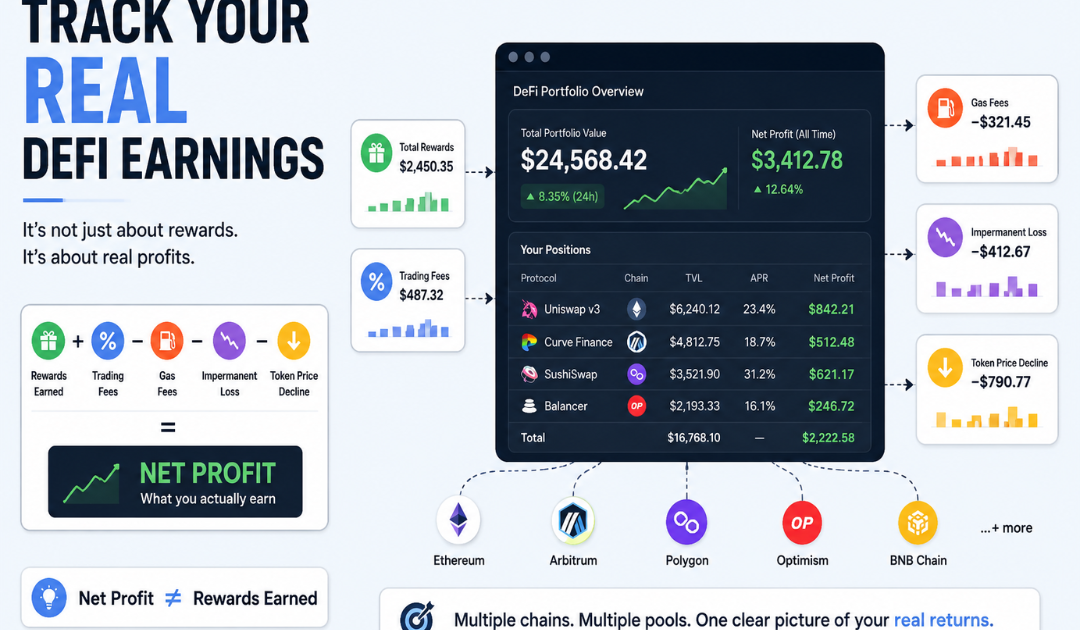
To track your yield farming rewards means monitoring your DeFi earnings and understanding how much you’re actually making. It involves tracking rewards, fees, APYs, token prices, and overall portfolio performance.
Tracking yield farming rewards becomes much more important once you start farming across multiple protocols and blockchains. At first, it might seem enough to check your rewards on each platform. But as your portfolio grows, it gets harder to know how much you’re actually earning. Changing APYs, gas fees, impermanent loss, and fluctuating token prices can all affect your returns, making it easy to overestimate your profits.
The DeFi ecosystem continues to manage tens of billions of dollars in Total Value Locked (TVL) across thousands of protocols, with current TVL hovering around $75 to $80 billion, according to DefiLlama. As more investors spread their assets across Ethereum, Arbitrum, Polygon, Optimism, and other networks, keeping track of rewards manually becomes increasingly difficult.
This guide shows you how to track DeFi rewards the right way. You’ll learn which metrics actually matter, how to calculate your real profits, the best tools to monitor your portfolio, and how to stay on top of your yield farming rewards across multiple chains without spending hours updating spreadsheets.
What Are Yield Farming Rewards?
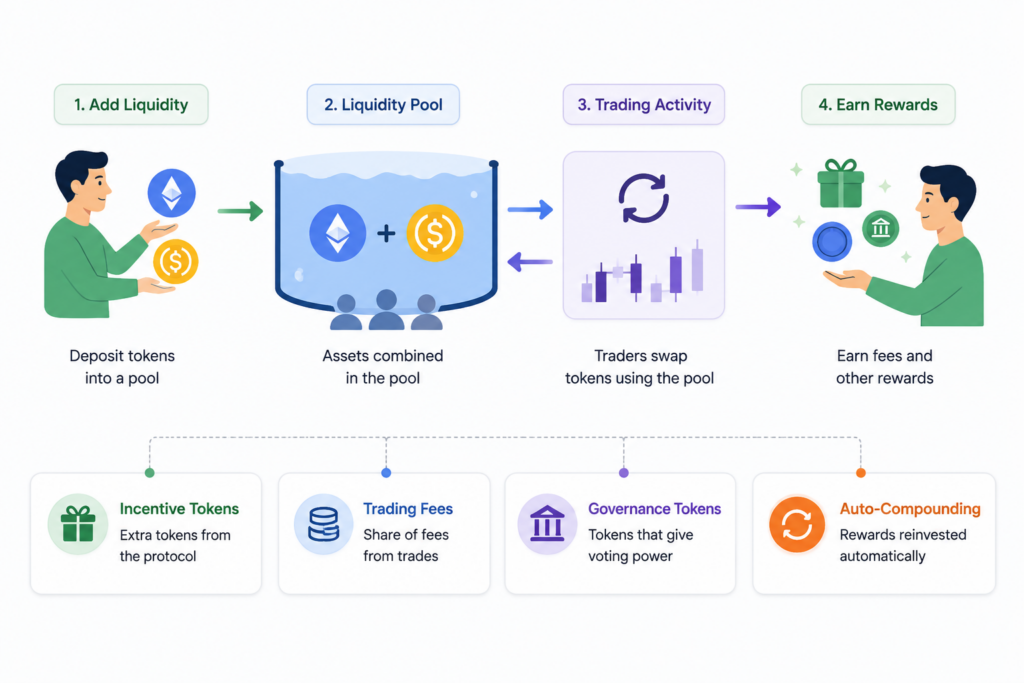
Yield farming rewards are what you earn when you lend your crypto to a DeFi protocol by adding it to a liquidity pool. The protocol uses those funds to help process trades or other DeFi transactions, and you receive rewards in return.
What Types of Yield Farming Rewards Can You Earn?
The exact rewards depend on the platform you’re using. You might earn incentive tokens paid out by the protocol, a share of the trading fees generated by the pool, governance tokens that let you vote on future changes, or auto-compounded rewards, where your earnings are automatically reinvested to help you earn even more.
What Are Liquidity Pools and LP Tokens?
A liquidity pool is simply a pool of crypto that users contribute to. When you add your funds, you receive LP tokens. Think of these as a receipt that proves your share of the pool. As long as you hold them, you’re entitled to your share of the rewards.
How Is Yield Farming Different From Staking?
Both let you earn passive income, but they work differently. With yield farming, you’re providing liquidity to a pool that other users trade against. With staking, you’re locking up your tokens to help validate transactions and secure a blockchain network.
Why Does Tracking Yield Farming Rewards Matter?
If you’re yield farming, simply watching your token balance isn’t enough. To understand whether you’re actually making money, you need to track your DeFi rewards and overall portfolio performance.
What Can Tracking Your Rewards Help You Do?
Tracking your yield farming rewards helps you measure your real returns after factors like changing APYs, gas fees, and token price movements. It also makes it easier to compare different liquidity pools, identify underperforming positions, and manage rewards spread across multiple DeFi platforms. On top of that, keeping a clear reward history can simplify tax reporting and help you spot losses caused by impermanent loss or falling token prices before they become more significant.
What Should You Track in a Yield Farming Portfolio?
To understand how your strategy is performing, you need to look beyond the rewards shown by the protocol. Tracking a few key metrics gives you a much clearer picture of your actual returns.
Which Metrics Matter Most?
Start with your total rewards earned to see how much you’ve accumulated over time. At the same time, keep an eye on unclaimed rewards so you don’t forget to collect them if the protocol doesn’t auto-compound.
Next, compare the APR and APY. APR shows the basic annual return, while APY includes the effect of compounding, making it a better indicator if you’re regularly reinvesting your rewards.
You should also monitor the value of your LP tokens and your overall portfolio value to see how your liquidity position changes over time. Since reward tokens can rise or fall in price, it’s worth tracking their value instead of just the number of tokens you receive.
Finally, don’t ignore gas fees and impermanent loss. These costs can quietly reduce your profits. The metric that matters most is your net profit, because it shows what you’ve actually earned after accounting for fees, price changes, and other costs.
How to Track Yield Farming Rewards (Step by Step)
Tracking yield farming rewards becomes much easier when everything is in one place. A simple DeFi portfolio tracker allows you to do that. There are many options out there, but for the rest of this guide, we’ll assume you’re using Chain Glance to monitor your DeFi portfolio.
Step 1: Connect Your Wallet to Chain Glance
Start by connecting the wallet you use for DeFi, whether it’s MetaMask, Trust Wallet, or another supported wallet. Most DeFi portfolio trackers, including Chain Glance, use a read-only connection, which means they can view your wallet’s on-chain activity but can’t move your funds or approve transactions.
Step 2: View Your Active Yield Farming Positions
Once your wallet is connected, Chain Glance automatically detects your active yield farming positions. You can see which liquidity pools you’ve joined, the LP tokens you hold, any staking positions, and the rewards you’ve earned so far. Instead of checking multiple protocols one by one, you get a single view of your entire DeFi portfolio.
Step 3: Monitor Your Rewards in Real Time
Now you can start tracking your yield farming rewards as they change. Keep an eye on both claimed and unclaimed rewards, your estimated daily earnings, and any changes in APY. If a protocol launches new incentives or adjusts its reward rate, you’ll be able to see how those changes affect your expected returns.
Step 4: Track Your Portfolio Across Multiple Blockchains
If you farm on more than one network, it’s important to monitor everything together. Chain Glance lets you track positions across Ethereum, Arbitrum, Polygon, Optimism, and BNB Chain from a single dashboard. As more DeFi opportunities move across different blockchains, cross-chain tracking helps you understand your total exposure and compare performance without switching between multiple apps.
Step 5: Export Your Transaction History
Finally, export your wallet history whenever you need it. CSV exports make it much easier to review past transactions, keep portfolio records, and prepare for crypto tax reporting. Having a complete transaction history also makes it easier to calculate your yield farming profits and track your performance over time.
What Are the Best Tools to Track Yield Farming Rewards?
There are plenty of tools that can help you track yield farming rewards, but each is designed for a slightly different type of user. Here are some of the most popular options.
Chain Glance is a strong all-round choice if you want to track DeFi rewards across multiple blockchains from one dashboard. It automatically detects your positions, tracks LP tokens and farming rewards, supports tax integrations, and keeps everything in one place, making it ideal for both beginners and experienced DeFi users.
DeBank is popular with advanced DeFi users because it offers detailed wallet analytics, protocol-level insights, and excellent multi-chain support. It’s particularly useful if you actively use several DeFi protocols.
Zerion focuses on simplicity and mobile usability. It gives you a clean overview of your portfolio, reward history, and asset performance, making it a good option if you primarily manage your crypto from your phone.
ApeBoard is designed for users with assets spread across many chains. It provides a consolidated view of your DeFi positions, including liquidity pools, lending platforms, and staking protocols.
DeFiLlama is best known for its protocol analytics rather than wallet tracking. It’s useful for comparing Total Value Locked (TVL), protocol growth, and ecosystem health before deciding where to farm.
Check out our in-depth guide if you’d like a more detailed comparison of these tools
Can You Manually Track Yield Farming Rewards?
Yes. You can track yield farming rewards manually, but whether it’s the best approach depends on how active you are in DeFi.
A spreadsheet is completely free and gives you full control over how you calculate rewards, fees, and profits. However, you’ll need to update it yourself by recording every deposit, withdrawal, reward claim, gas fee, and token price change. That can become time-consuming, especially if you’re farming across multiple protocols or blockchains. It’s also easier to make mistakes when entering data manually. Read more about this here.
A DeFi portfolio tracker like Chain Glance automates most of the work. It syncs your wallet, updates your positions in real time, tracks rewards across multiple chains, and gives you a much clearer view of your portfolio with minimal effort. While some trackers offer premium features, many also have free plans that are enough for most users.
If you only have one or two positions and enjoy analyzing your investments yourself, a spreadsheet may be all you need. But if you’re actively yield farming, managing multiple wallets, or farming on networks like Ethereum, Arbitrum, and Polygon, an automated DeFi portfolio tracker will usually save you time and give you a more accurate picture of your returns.
How Do You Calculate Your Actual Yield Farming Profit?
The rewards you earn aren’t always the same as the profit you keep. To calculate your net yield farming returns, you also need to account for costs and losses along the way.
Net Profit = Reward Value + Trading Fees − Gas Fees − Impermanent Loss − Token Price Decline
For example, imagine you earn $250 in reward tokens and $50 in trading fees. If you spend $30 on gas, lose $40 to impermanent loss, and your reward tokens fall by $60 before you sell them, your actual profit is $170, not $300.
If you’re using Chain Glance, this process becomes much easier. It integrates directly with Bitcoin.Tax, allowing you to automatically sync your transactions, calculate taxable yield farming income, and simplify your tax reporting instead of doing everything manually.
How Can You Track Rewards Across Multiple DeFi Platforms?
Tracking yield farming rewards across multiple DeFi platforms can get complicated quickly. You might have positions spread across different wallets, blockchains, and protocols, making it difficult to see your total portfolio or calculate your actual returns.
Using a DeFi portfolio tracker like Chain Glance solves this by bringing all your assets into one dashboard. You can monitor rewards from different protocols, track LP positions across multiple chains, and keep your transaction history organized without switching between apps.
If you want a deeper walkthrough, check out our in-depth guide.
What Are the Most Common Challenges When Tracking Yield Farming Rewards?
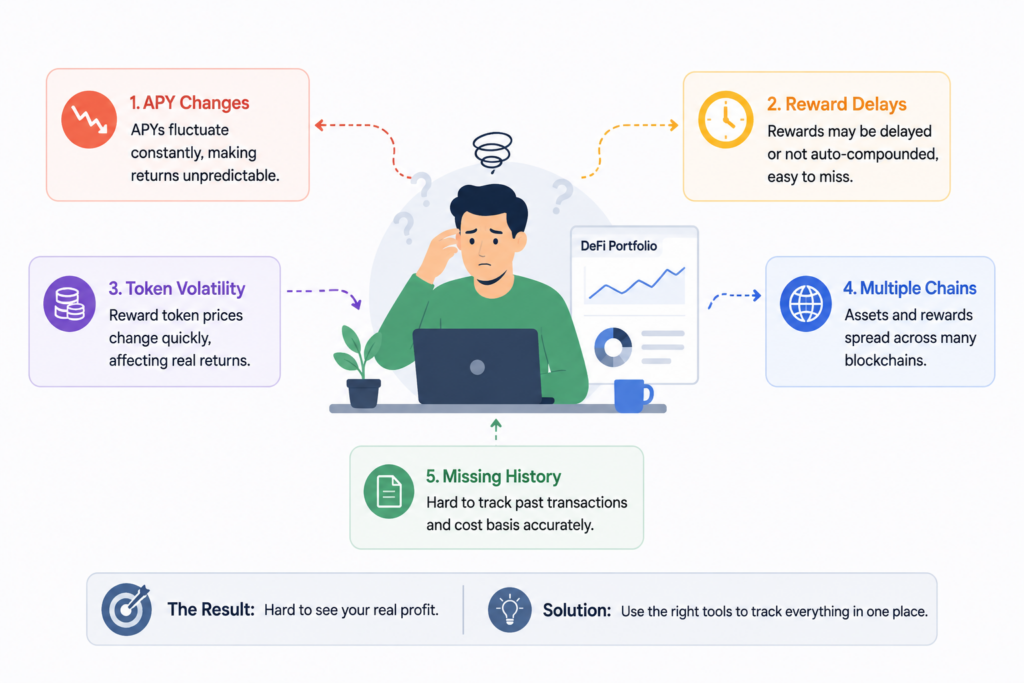
Tracking yield farming rewards isn’t always straightforward because your portfolio is constantly changing.
Changing APYs: APYs change frequently, so projected returns can look very different from what you actually earn.
Delayed Reward Updates: Reward updates may be delayed, meaning your dashboard doesn’t always reflect the latest earnings instantly.
Reward Token Volatility: You might earn more tokens over time, but if their price falls, your profits can shrink.
Multiple Wallets and Chains: Managing multiple wallets and cross-chain assets makes it harder to get a complete view of your portfolio.
Missing Transaction History: Missing historical transactions can complicate performance tracking and tax reporting.
Changing Reward Structures: DeFi protocols regularly update their reward structures, making manual tracking even more difficult.
The easiest way to deal with these challenges is to review your portfolio regularly, keep your transaction history organized, and use a DeFi yield tracker like Chain Glance, which consolidates your positions, tracks rewards across multiple chains, and automatically updates your portfolio in one place.
What Common Mistakes Should You Avoid When Tracking Yield Farming Rewards?
Focusing Only on APY: A high APY doesn’t always mean higher profits once you factor in gas fees, impermanent loss, and falling token prices.
Forgetting Unclaimed Rewards: Unclaimed rewards can sit idle if you don’t check your positions regularly.
Tracking Each Blockchain Separately: If you’re farming across multiple blockchains, tracking each network separately makes it harder to see your true portfolio performance.
Relying on Unreliable Tracking Tools: Inaccurate tracking tools can give you incorrect data about your positions and returns.
Failing to Back Up Transaction History: Not keeping a backup of your transaction history can create problems during tax season.
The best approach is to track your yield farming rewards in one place, monitor your actual net returns, and regularly export or back up your transaction records.
Taxes on Yield Farming Rewards
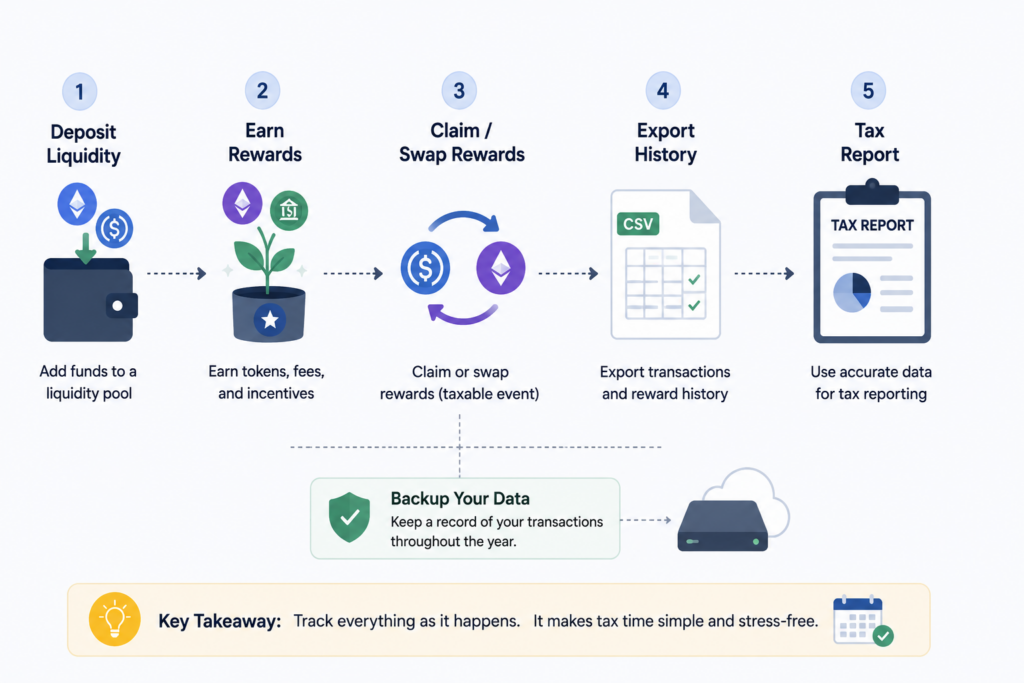
Keeping track of your yield farming rewards throughout the year makes tax reporting much easier. Instead of trying to reconstruct months of transactions later, you’ll already have a complete record of your earnings and activity.
Start by maintaining your transaction history, including deposits, withdrawals, reward claims, and token swaps. Regularly exporting your wallet history also gives you a reliable backup if you need to verify transactions later.
It’s also important to understand the difference between cost basis and capital gains. In many jurisdictions, the value of reward tokens when you receive them may be treated differently from any gain or loss that occurs when you eventually sell them.
Using crypto tax software can automate much of this process. If you use Chain Glance, you can sync your portfolio directly with Bitcoin.Tax, making it easier to calculate taxable rewards, organize transactions, and prepare accurate tax reports.
Frequently Asked Questions
How Often Should You Check Your Yield Farming Rewards?
That depends on how active your strategy is. If you’re farming in pools with frequently changing rewards or moving funds between protocols, checking your portfolio every few days can help you spot changes in APY, rewards, or profitability. For longer-term positions, a weekly review is usually enough.
Can You Track Yield Farming Rewards Without Connecting Your Wallet?
Yes. Most DeFi portfolio trackers let you track a wallet using its public wallet address. This creates a read-only view of your portfolio, allowing you to monitor positions, rewards, and performance without giving the tracker permission to move your funds.
Do You Need to Claim Rewards Before They Appear in Your Portfolio?
Not always. Many portfolio trackers display both claimed and unclaimed rewards, so you can see what you’ve earned even if you haven’t claimed it yet. However, whether unclaimed rewards appear depends on the DeFi protocol and the tracker you’re using.