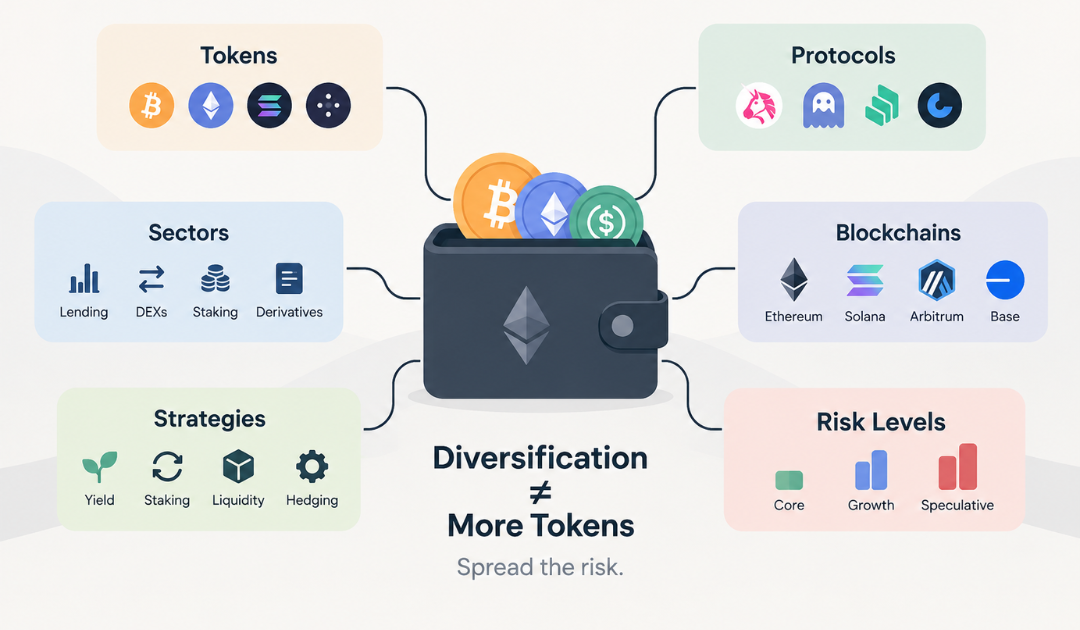
You can diversify a DeFi portfolio by spreading funds across different tokens, protocols, blockchains, sectors, and risk levels. This helps reduce concentration risk and limit losses from a single failure.
But honestly, diversifying a DeFi portfolio isn’t as simple as spreading your money across a bunch of tokens. You can hold 20 different assets and still have most of your portfolio exposed to the same blockchain, stablecoin, oracle, or protocol. That makes diversification harder in DeFi than it first appears.
The risks are real. Chainalysis reported that smart-contract vulnerabilities and code exploits accounted for about 8.5% of funds stolen between January and November 2024. Add liquidity problems, stablecoin depegging, bridge exploits, and protocol failures, and a portfolio that looks diversified on paper can still have significant concentration risk.
This guide breaks down DeFi portfolio diversification in practical terms. You’ll learn how to spread exposure across sectors, protocols, blockchains, strategies, and risk levels, how to stress-test your portfolio, and how tools like Chain Glance can help you keep track of everything as your portfolio grows.
What Does DeFi Portfolio Diversification Mean?
If you’re building a DeFi portfolio, diversification means spreading your money across different assets, protocols, sectors, blockchains, and types of risk. The idea is simple: you don’t want one failed protocol, hacked blockchain, or collapsing token to wipe out a large part of your portfolio.
There are a few ways you can diversify:
- Token diversification: Hold multiple crypto assets instead of relying on one.
- Protocol diversification: Spread funds across different DeFi applications.
- Sector diversification: Combine lending, DEXs, staking, derivatives, and other DeFi sectors.
- Chain diversification: Use multiple blockchains instead of depending entirely on one.
- Risk diversification: Choose investments that aren’t all exposed to the same underlying failure.
The last one is especially important because asset diversification ≠ risk diversification. You could own 10 different tokens but still have most of your money exposed to the same blockchain or protocol.
As you spread your funds across more wallets, chains, and protocols, keeping track of everything can also get messy. A DeFi portfolio tracker like Chain Glance can bring those positions into one view, making it easier to see where your money is actually concentrated.
Why Diversify a DeFi Portfolio At All?
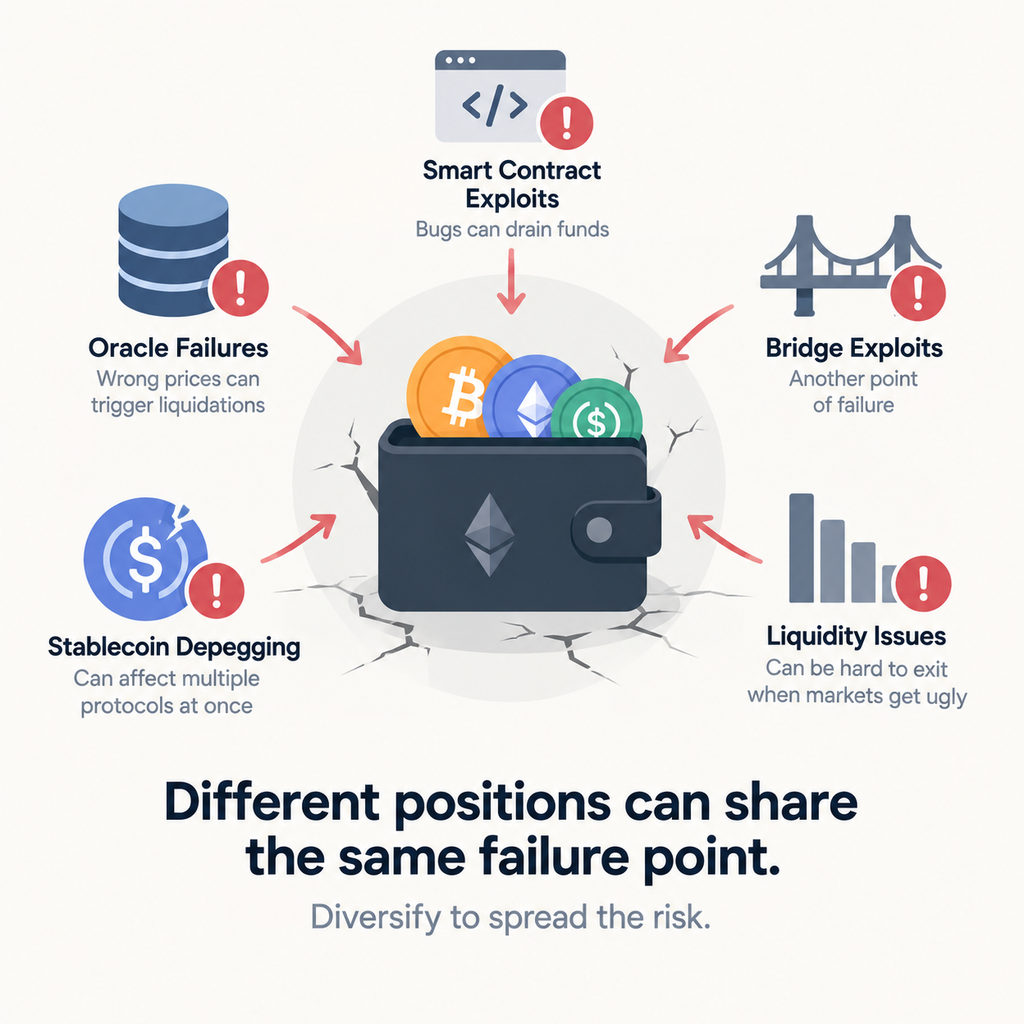
Putting your money into several DeFi protocols doesn’t automatically make your portfolio safer. You also need to think about what could go wrong with each position.
For example, a smart-contract exploit can drain the funds you’ve deposited. An oracle failure can send a protocol the wrong price and trigger liquidations. Bridges create another point of failure, while a stablecoin depeg can hit several protocols at once if they all rely on the same asset. When markets get ugly, liquidity can also dry up just when you need to exit.
This is why chasing the highest APY isn’t always the best DeFi investment strategy. A high yield can come with much higher risk. Good diversification is about spreading those risks, not simply collecting more tokens.
The 6 Ways to Diversify a DeFi Portfolio
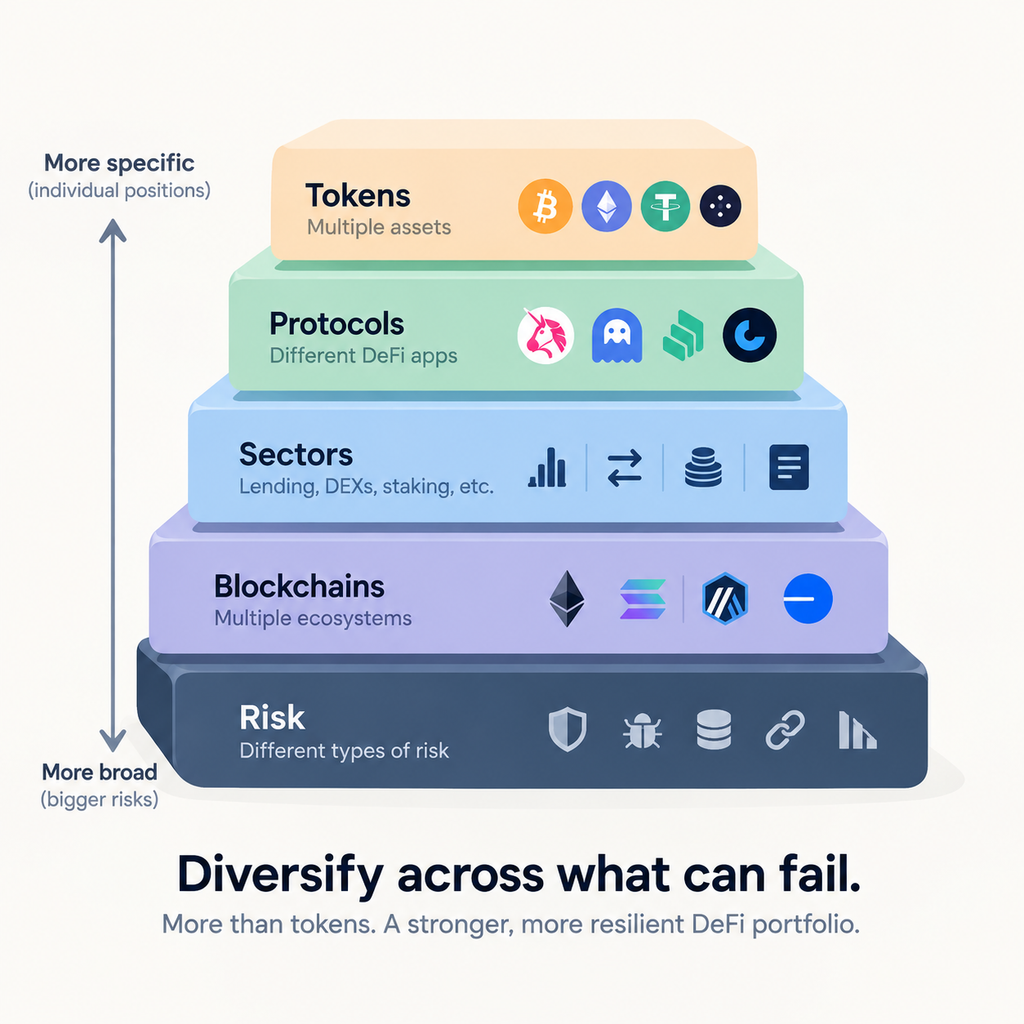
If you’re building a DeFi portfolio, don’t just count your tokens. Look at where your money is being used, which protocols hold it, and what risks they share.
1. Diversify Across DeFi Sectors
You can spread your money across lending, DEXs, liquid staking, derivatives, stablecoins, and other sectors. But five lending positions aren’t much different from one large lending position if they face similar risks.
Also look for shared dependencies. Several protocols might rely on the same stablecoin, oracle, blockchain, or infrastructure. If that dependency fails, multiple positions can be affected at once.
2. Diversify Across Protocols
Putting too much money into one protocol creates concentration risk. A hack, smart-contract bug, or liquidity crisis could put a large part of your portfolio at risk.
Before using a protocol, look at its audit history, bug bounty, TVL, track record, upgrade controls, and dependencies. But don’t treat an audit as a guarantee. Audits can’t prevent future bugs or exploits.
Two different protocols can also rely on the same code or infrastructure. That’s another shared failure point worth checking.
3. Diversify Across Blockchains
Keeping everything on one chain creates another type of concentration risk. You can spread exposure across ecosystems such as Ethereum, Solana, Arbitrum, and Base.
But more chains also mean more complexity. Bridges add another attack surface, liquidity gets fragmented, and you have more ecosystems to manage. Diversification isn’t useful if it creates risks you wouldn’t otherwise have.
4. Diversify Stablecoin Exposure
Stablecoins have different risks. Fiat-backed stablecoins can face issuer, custodial, and regulatory risks, while decentralized stablecoins can face smart-contract, oracle, and depeg risks.
Don’t assume that holding several stablecoins means you’re well diversified either. If multiple positions depend heavily on the same stablecoin, one problem can affect all of them.
5. Diversify Your Yield Strategies
Don’t choose strategies based only on the highest APY. First understand where the yield comes from.
Lending and liquidity provision depend on different sources of return and carry different risks. Liquidity provision can create impermanent loss, leverage can trigger liquidations, and yield farming can become much less profitable when token incentives fall.
6. Diversify by Risk Level
Not every position needs to carry the same level of risk. You can keep most of your portfolio in established protocols and simpler strategies while keeping smaller amounts in newer protocols, speculative tokens, leverage, or high-yield opportunities.
The key is deciding how much you’re willing to lose in each category. And remember, “lower risk” doesn’t mean safe. DeFi still comes with smart contracts, liquidity, governance, and market risk.
How to Build a Diversified DeFi Portfolio
If you want to know how to build a diversified DeFi portfolio, don’t start by copying someone else’s allocation. Start by figuring out how much risk actually makes sense for you, then build around that.
Step 1: Figure Out How Much Risk You Can Take
Before putting money anywhere, ask yourself a few uncomfortable questions. How much could you afford to lose? How long can you leave the money invested? Will you need access to it soon? And how much volatility can you realistically handle without panic-selling?
Your answers should shape your DeFi portfolio allocation.
Step 2: Decide What Each Part of Your Portfolio Is For
Not every position needs to do the same thing. You might keep some money in core holdings, add established DeFi protocols, use another portion for generating yield, keep some stablecoin liquidity, and reserve a smaller amount for higher-risk opportunities.
This gives every position a purpose instead of turning your portfolio into a collection of random tokens.
Step 3: Put Limits on Your Exposure
Set a maximum amount you’re comfortable putting into any one protocol, token, blockchain, stablecoin, or strategy.
You don’t need to follow a universal percentage. The point is to decide your limits before a position grows large enough to become a problem. You might also want tighter limits for newer protocols or strategies you haven’t seen tested through different market conditions.
Step 4: Look for Risks You’re Repeating
This is the step that’s easy to miss. Before adding another position, ask:
Does this depend on infrastructure I already heavily rely on?
Five different protocols aren’t much help if they all use the same oracle, stablecoin, blockchain, or underlying code.
And as your portfolio gets spread across more wallets, chains, and protocols, keeping track of all these positions manually gets messy fast. A DeFi portfolio tracker like Chain Glance can pull your holdings into one view, making it easier to see where your money is actually concentrated and whether you’re taking the same risk in several different places.
Example of a Diversified DeFi Portfolio
Let’s make this practical. Say you’re putting together a DeFi investment portfolio and want different parts of it to serve different purposes. Your portfolio might look something like this:
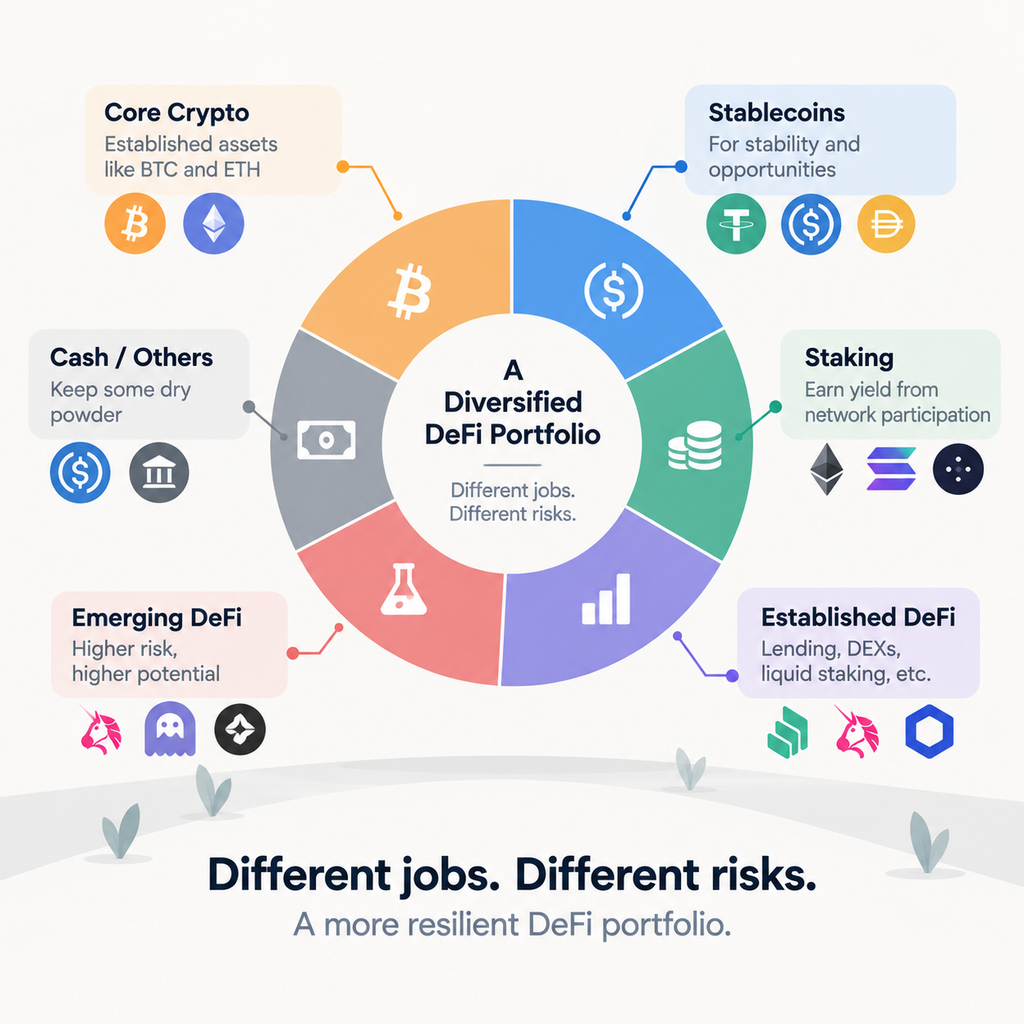
Now here’s where things can get misleading.
You could put money into five different Ethereum protocols and feel like you’ve diversified. But what if they all use the same stablecoin, rely on the same oracle provider, use the same bridge, and offer similar lending strategies? If that shared infrastructure runs into trouble, several of your positions could be affected at the same time.
A better approach is to look at what could actually cause you to lose money. Spread your exposure across different types of DeFi activity, use different yield mechanisms, keep chain exposure under control, and avoid relying too heavily on the same infrastructure.
And as you add more wallets, chains, and protocols, keeping track of all those moving parts becomes difficult. A DeFi portfolio tracker like Chain Glance can give you one place to see your positions and spot concentration that isn’t obvious at first glance.
The point isn’t to own more things. It’s to avoid taking the same risk over and over again.
How to Stress-Test Your DeFi Portfolio
Want to know whether your DeFi portfolio diversification actually works? Try breaking it on paper before the market does it for you.
Ask yourself what happens in a few ugly scenarios:
- ETH falls 40%: How much of your portfolio falls with it?
- A major stablecoin loses its peg: How many of your positions are suddenly affected?
- Your largest DeFi protocol gets exploited: What percentage of your capital is sitting there?
- A major blockchain goes offline: How much of your money becomes inaccessible?
- A bridge you use gets hacked: How much of your portfolio depends on that bridge?
- DeFi yields collapse: Would your strategy still make sense without those returns?
You don’t need to predict which event will happen. You’re trying to find out how badly your portfolio would react if it did.
This is also where a DeFi portfolio tracker like Chain Glance can help. Having your positions across wallets and chains in one place makes it easier to see exactly how much capital is exposed to each scenario.
The goal is simple: if one event can damage most of your positions at once, your portfolio isn’t genuinely diversified.
How to Manage and Rebalance a DeFi Portfolio
Your DeFi portfolio won’t stay in the same shape forever. Prices move, yields change, and some positions can grow much faster than others. That’s why it’s worth checking your allocations regularly instead of setting them once and forgetting about them.
You can rebalance on a schedule, such as once every few months, or only when something changes. Calendar-based rebalancing gives you a regular check-in, while threshold/event-based rebalancing means you act when a position gets too large or something important happens.
For example, you might cut back a position after a major exploit, rethink a protocol after a governance change, or review your stablecoin exposure after a depeg. If one asset has grown far beyond the size you originally wanted, that can also be a reason to rebalance.
This gets harder when your money is spread across multiple wallets, chains, and protocols. A DeFi portfolio tracker like Chain Glance lets you see those positions together, so you can spot an oversized position without checking everything separately.
Just don’t rebalance for the sake of it. Gas fees add up, and an asset going up isn’t automatically a reason to sell. Look at whether the underlying risk and reward still make sense.
Common DeFi Diversification Mistakes
It’s easy to think you’re diversified when you’re really just spreading the same risks across more positions. Here are some mistakes to watch for:
Mistake 1: Owning too many tokens
Holding 20 tokens doesn’t help much if most of them move with the same market or depend on the same ecosystem.
Mistake 2: Chasing APY
A huge yield can look attractive, but it may come with leverage, weak liquidity, token incentives, or higher smart-contract risk.
Mistake 3: Ignoring shared infrastructure
Five different protocols can still depend on the same oracle, bridge, stablecoin, or blockchain.
Mistake 4: Treating audits as guarantees
An audit can find vulnerabilities, but it can’t guarantee that a protocol won’t be exploited later.
Mistake 5: Over-diversifying
If you have too many positions to monitor properly, diversification can become a management problem.
Mistake 6: Ignoring liquidity
A portfolio can look diversified on paper, but that doesn’t help much if you can’t exit your positions efficiently during a market shock.
Mistake 7: Not using a portfolio tracker
When your assets are spread across multiple wallets, protocols, and chains, it’s easy to lose track of what you actually own and where your biggest exposures are. A good tracker (like Chain Glance) can bring everything into one place, making it easier to spot concentration and manage your portfolio. Moreover, it can also make filing for taxes later easier.
Read our full list of the best DeFi portfolio trackers to learn more.
Frequently Asked Questions
1. What Is the 7% Rule in ETFs?
The 7% rule is a general investing guideline that says you can consider selling an ETF if it falls about 7% below your purchase price. The idea is to limit losses before they become larger.
However, it isn’t a universal ETF rule or requirement. ETFs can fluctuate normally, so selling every time one drops 7% may not make sense for a long-term investor. Whether to use a 7% stop-loss depends on your investment strategy, risk tolerance, and the type of ETF you’re holding.
2. Should I keep some crypto outside DeFi?
It can make sense, depending on your goals and risk tolerance. Keeping part of your holdings outside DeFi means not all of your capital depends on smart contracts, DeFi protocols, or on-chain strategies. BTC, ETH held directly, or unused capital can serve a different role from funds actively deployed in DeFi.
3. Can diversification reduce my DeFi returns?
It can. Spreading money across lower-yield strategies or less aggressive positions may mean giving up some potential upside compared with concentrating everything in the highest-yield opportunities. But the trade-off is that you’re also avoiding having too much capital tied to one strategy or risk source.