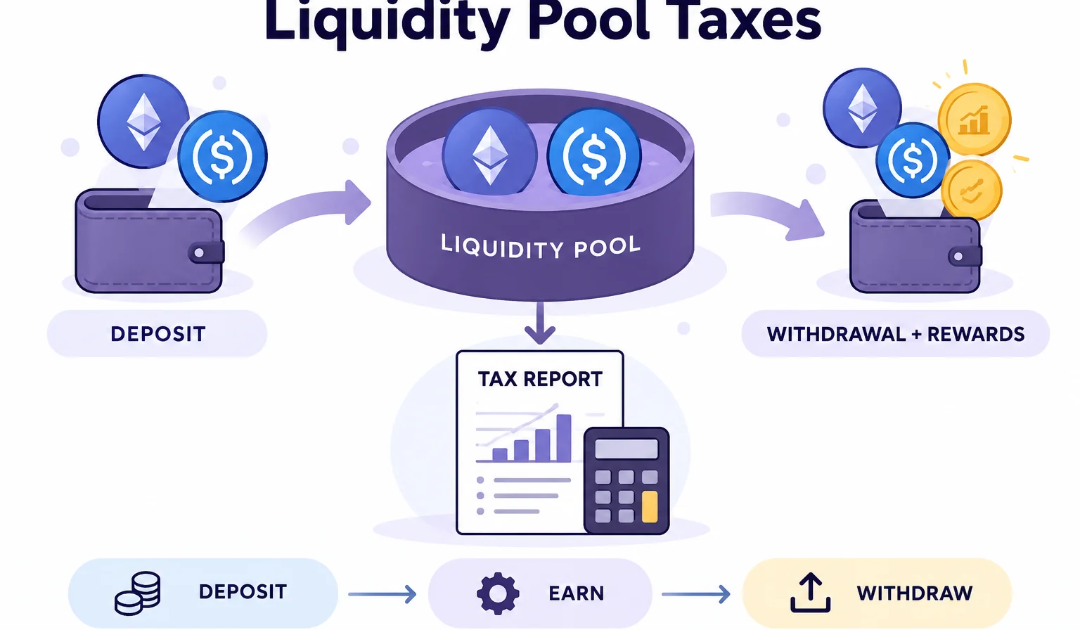
Liquidity pool taxes explain how crypto deposits, withdrawals, and rewards earned from liquidity pools may be taxed. They cover how to calculate potential capital gains or losses, understand the tax implications of impermanent loss, and track transactions for accurate crypto tax reporting.
Liquidity pool taxes can get messy pretty quickly. You might be tracking deposits, withdrawals, LP tokens, and rewards across several wallets, all while trying to figure out what’s taxable.
To make things trickier, the rules vary by country. A liquidity pool deposit that may trigger capital gains tax in one place could be treated differently somewhere else. And if your transaction records are incomplete, calculating your gains or losses can turn into a real headache.
So, how do you work out what you owe without getting buried in tax rules?
This guide breaks down how liquidity pool deposits and withdrawals may be taxed, how LP tokens and rewards affect your calculations, and whether you can claim a tax deduction for impermanent loss. You’ll also learn how the rules differ in the US, UK, and Australia, plus how to organize your transaction records to make tax reporting easier.
What Is a Liquidity Pool?
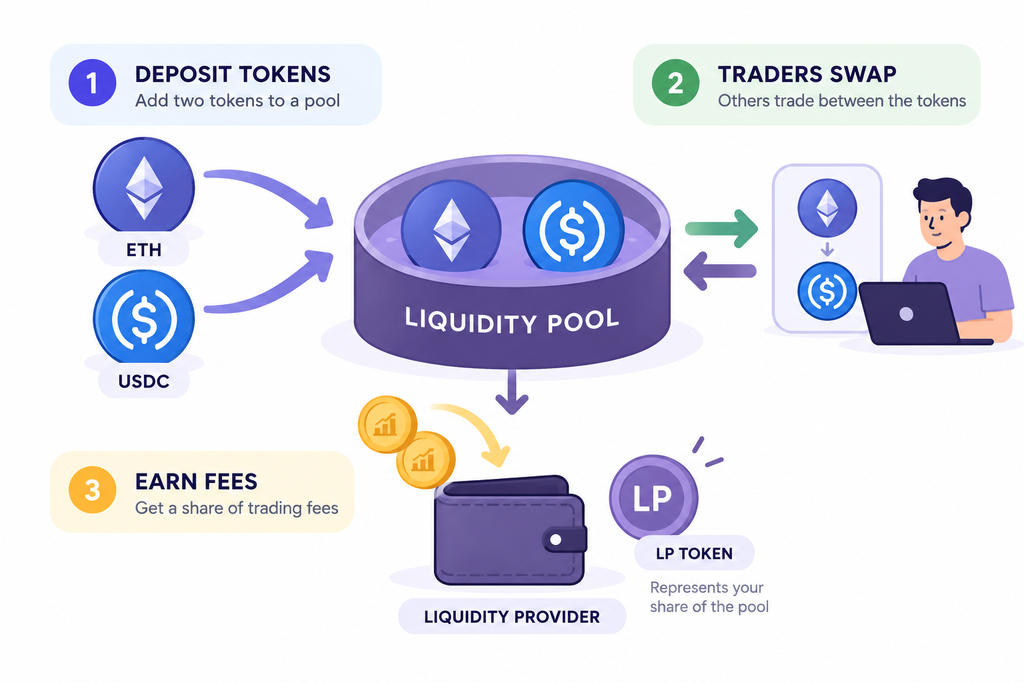
Imagine a shared pot of crypto that people can use to trade. That’s basically a liquidity pool.
Say you put 1 ETH and 2,000 USDC into a pool on a decentralized exchange (DEX). Other people can swap ETH for USDC, or USDC for ETH, using the crypto in that pot. You don’t need to find someone willing to trade with you directly, which is how traditional trading platforms work via order books, where every buyer is matched with a seller instantly.
In return for adding your crypto, you may earn a share of the trading fees. You also get a record of your share of the pool, often called an LP token, which can be a coin on its own that can appreciate and depreciate in value like other cryptocurrencies.
Now, here’s the important part: when you take your crypto back out, you might not get exactly 1 ETH and 2,000 USDC. Other people have been trading, so the amounts in the pool have changed.
For example, if traders buy ETH from the pool, it ends up with less ETH and more USDC. When you withdraw your share, you could receive less ETH and more USDC than you initially deposited.
The total value of your withdrawal can also differ from what you would have had by simply holding the original tokens. This difference is known as impermanent loss. The trading fees you earn may help offset that loss, but they don’t guarantee a profit.
Why does this matter for taxes? You need to know what crypto you put in, what you got back, and whether you earned any rewards. Depending on your country’s tax rules and how the transaction is treated, these changes may affect your tax bill.
Understanding Liquidity Pool Taxes
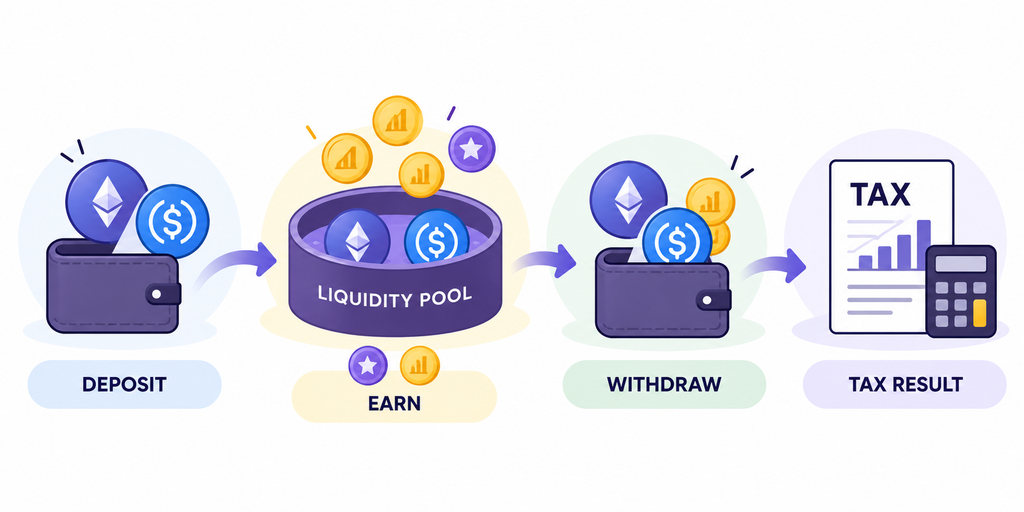
Liquidity pool taxes can apply at different stages, from depositing crypto to earning rewards and withdrawing your assets. Let’s walk through a single example to understand when taxes may apply, how to calculate potential gains, and what to track for accurate tax reporting.
Here’s your starting point: You bought 1 ETH for $2,000 and 3,000 USDC for $3,000. Your total cost basis is $5,000.
1. Are Liquidity Pool Deposits Taxable?
Liquidity pool deposits can trigger capital gains tax, depending on your country’s tax rules and how the transaction is structured. Some tax authorities treat deposits as taxable disposals, while others have unclear rules that leave room for interpretation.
Let’s look at an example.
You bought 1 ETH for $2,000 and 3,000 USDC for $3,000. When you deposit them into a liquidity pool, ETH is worth $3,000, bringing your total deposit value to $6,000.
If the deposit qualifies as a taxable disposal, your potential capital gain would be:
- Deposit value: $6,000
- Original cost basis: $5,000
- Potential capital gain: $1,000
The value of any LP tokens you receive may also establish their starting cost basis, depending on the applicable tax rules.
Why Can a Liquidity Pool Deposit Count as a Taxable Disposal?
Many tax authorities classify crypto as property, meaning swaps can trigger capital gains tax even when you don’t cash out to fiat. Some apply this principle to liquidity pool deposits, treating crypto transferred in exchange for LP tokens or other rights as a disposal.
For example, Australia’s Taxation Office (ATO) treats these transfers as capital gains tax (CGT) events. In the US, however, the IRS has not issued comprehensive guidance specifically addressing all types of liquidity pool deposits.
Taxpayers may take a conservative approach by reporting deposits as disposals or a more aggressive position by not reporting them as disposals. The latter carries the risk of an IRS challenge; unclear guidance does not mean the transaction is automatically tax-free. Similar interpretive uncertainty exists in other jurisdictions where specific rules are lacking.
2. Are Liquidity Pool Rewards and Fees Taxable?
Mostly, yes. The tax treatment depends on what you earn, how you receive it, and where you pay tax.
Liquidity providers can earn returns in two main ways:
- Reward tokens: A protocol sends extra tokens to your wallet as an incentive.
- Trading fees: Traders pay fees, which may increase the value of your pool position.
Tax Treatment of Liquidity Pool Rewards vs. Trading Fees
How your liquidity pool earnings are taxed depends on whether you receive reward tokens or earn trading fees inside the pool.
1. Reward Tokens (e.g., SUSHI)
If you claim 100 SUSHI worth $200, you may need to report $200 as income, depending on your country’s tax rules. If you later sell them for $300, you could owe capital gains tax on the additional $100.
2. Trading Fees (e.g., Uniswap)
Trading fees that accumulate inside a pool may not be taxed as income immediately. Instead, tax may apply when you withdraw your liquidity. The treatment depends on your country’s rules and how the pool works.
Remember: Reward tokens and in-pool fees can have different tax treatments, so check your local rules before reporting them.
3. Are Liquidity Pool Withdrawals Taxable?
Yes, withdrawing crypto from a liquidity pool can trigger capital gains tax, depending on your country’s rules.
When you withdraw, you exchange your LP tokens for the crypto in the pool. Since token balances change as people trade, you may receive different amounts than you originally deposited.
Tax authorities may treat withdrawals in three ways:
- LP token disposal: Compare the value of the crypto received with your LP tokens’ cost basis. If your basis is $10,000 and you receive $7,500, you could have a $2,500 capital loss.
- Token rebalancing: Tax may apply to crypto effectively exchanged inside the pool. If you deposit 2 ETH but withdraw 0.8 ETH, the remaining 1.2 ETH may be treated as disposed of.
- Tax deferral: Some jurisdictions may defer tax until you sell or exchange the withdrawn assets.
Quick Checklist for Liquidity Pool Tax Reporting
| Activity | What to track |
| Deposit | Tokens deposited, their market value, original cost basis, and LP tokens or position received |
| Rewards | Reward token amount, value when received, and date |
| Withdrawal | LP tokens or position surrendered, assets received, market values, and associated fees |
Keep these records for every transaction. They’ll help you calculate your gains or losses and work out what you need to report under your country’s tax rules.
What Is Impermanent Loss, and Can You Claim It on Your Taxes?
Impermanent loss is what happens when the prices of the cryptos you put into a pool shift, leaving you with less total value than if you’d just kept those same tokens sitting in your crypto wallet.
Liquidity pools use an automated formula to keep the total value of both sides of a trading pair balanced.
When the market price of one token goes up, traders and arbitrage bots rush in to buy that cheap token out of the pool while dumping the other token in. This means the pool automatically trades away your winning asset and leaves you holding more of the lagging asset.
So when you finally withdraw your share, you won’t get your original token counts back. You’ll walk away with less of the rising token and more of the cheaper one, and that value gap is your impermanent loss.
How Do You Handle Impermanent Loss on Your Taxes?
Tax agencies like the IRS or HMRC don’t have a specific box on your tax form labeled “Impermanent Loss.” However, tax pros and crypto CPAs usually handle this in one of three ways depending on your setup:
- Claiming it as a capital loss upon withdrawal: As long as your crypto is still sitting in the pool, you can’t claim any tax deduction because the loss is technically still “impermanent.” But the moment you redeem your LP tokens and pull your assets out, that loss becomes permanent. If your original LP position cost $5,000 to enter and you withdraw $3,500 worth of crypto, you can report a $1,500 capital loss to help lower your overall crypto taxes.
- Treating the balance change as a trade: Other tax experts look at the net change in your actual tokens. If you put in 1 ETH and 2,000 USDC, but withdraw 0.5 ETH and 3,000 USDC, the pool essentially sold 0.5 ETH on your behalf to buy 1,000 USDC. Under this view, you calculate a capital gain or loss specifically on that sold 0.5 ETH based on what you originally bought it for versus its price when you withdrew.
- The income vs. capital loss mismatch: If you earn reward tokens while yield farming, your local tax rules might count those rewards as ordinary income the moment you claim them. This can create a tricky situation where you owe income tax on your earnings right away, even if an impermanent loss leaves you down on your actual crypto deposit.
How Do You Calculate and Report Liquidity Pool Taxes?
Calculating taxes on liquidity pool activity, deposits, LP tokens, reward tokens, and final withdrawals can get messy fast. Chain Glance simplifies the process by automatically pulling your entire on-chain DeFi history across 60+ blockchains into one dashboard.
Here is how to get your records tax-ready using Chain Glance:
1. Connect Your Wallets: Add your public wallet addresses so Chain Glance can instantly scan your multi-chain DeFi activity.
2. Auto-Track Pool Deposits: The app automatically logs the tokens you put into a pool, captures their fair market values at that moment, and links them to the LP tokens or NFT positions in your wallet.
3. Capture Yield & Fees: Chain Glance tracks earned reward tokens and trading fees so you can properly account for taxable income when rewards are claimed.
4. Log Pool Withdrawals: When you burn your LP tokens to exit a pool, the platform records the returned tokens and accounts for any balance shifts caused by impermanent loss.
5. Review & Export: Check your transaction log, ensure gas fees and smart contract interactions are correctly labeled, and download your complete history as a CSV file.
6. Calculate & File: Upload your Chain Glance CSV directly into crypto tax software (like Bitcoin.Tax, which has a built-in Chain Glance importer) or hand it to your CPA to compute your final gains and losses.
Frequently Asked Questions About Liquidity Pool Taxes
Can I use wallet transaction history to calculate liquidity pool taxes?
Wallet history is a good starting point, but it may not show what each DeFi transaction actually did. For every deposit, withdrawal, or reward, record the protocol, token amounts, transaction date, and market value at the time. If a transaction is unclear, check the blockchain explorer and the protocol’s transaction details before classifying it for tax purposes.
What happens if I lose access to my LP tokens?
Don’t automatically report the position as a loss. First, check whether the LP tokens were transferred, burned, sent to another wallet, or simply became inaccessible. Save the transaction hash and records showing your original deposit. If the underlying assets are still in the pool, losing access alone may not count as a taxable disposal. Check your local rules before claiming a loss.
Do gas fees count toward my liquidity pool cost basis?
Keep a record of each gas fee, including the amount, currency, date, and related transaction. Then check whether your country’s rules allow it to be added to an asset’s cost basis or deducted as a transaction expense. Don’t count the same fee twice.
Can I use one tax report for multiple wallets?
Yes, and you should. Combining all your wallets into a single report ensures transfers between your own accounts aren’t miscounted as taxable sales.
Chain Glance connects all your public wallet addresses and exchanges in one place. It automatically tracks your complete DeFi history across 50+ blockchains, matches self-transfers, and lets you export a single, consolidated CSV to compute your final taxes.